Editorial illustration of basketball betting with NBA arena and EuroLeague court, basketball with odds graphics, blue and gold color scheme
New

How to Bet on Basketball: NBA & EuroLeague Point Spreads Guide

Jump to section

Introduction

Basketball betting might be the most accessible entry point for anyone new to sports wagering. Think about it—you've got high-scoring games, endless statistics to analyze, and an 82-game NBA season that gives you plenty of chances to learn without waiting around.

I've been betting on basketball for years, and I'll tell you straight: nothing beats the thrill of a live NBA game with some money on the line. But here's the thing—basketball also rewards the bettors who put in the work. Unlike sports where a single lucky bounce decides everything, basketball's high-scoring nature creates patterns you can actually identify and exploit.

Let me walk you through everything you need to know about betting on hoops, from reading odds like a pro to building strategies that actually work in both the NBA and EuroLeague.
Why Basketball's Perfect for First-Time Bettors

Here's what makes basketball different from soccer or hockey: one fluke goal doesn't ruin your night. When a game has 200+ combined points, the better team usually wins. That predictability matters when you're putting money on the line.

The NBA schedule also gives you a massive advantage. With multiple games every night from October through June, you get constant opportunities to practice, learn, and refine your approach. Compare that to football where you wait a week between games—basketball lets you iterate much faster.

And the live betting? That's where basketball really shines. Games shift momentum constantly, and if you're watching live, you can spot opportunities before the sportsbooks adjust their lines. I've caught some nice winners just by noticing a team's energy change in the third quarter.

First, though, let's make sure you understand what you're looking at when you see those numbers next to team names.

Reading Basketball Odds Like a Pro

Those numbers with plus and minus signs tell you two things: how much you'll win, and how likely something is to happen. Simple enough, right?

American Odds Format

Here's what you'll see at American sportsbooks:

Negative odds (favorites):

  • -110: Bet $110 to win $100
  • -150: Bet $150 to win $100
  • -200: Bet $200 to win $100

The minus sign means favorite. The number shows what you need to risk to profit $100.

Positive odds (underdogs):

  • +110: Bet $100 to win $110
  • +150: Bet $100 to win $150
  • +200: Bet $100 to win $200

Plus signs mean underdog. The number is your profit on a $100 bet.

The Vig: Why It's Harder Than It Looks

Notice how most spreads and totals have -110 on both sides? That $10 difference is called the "vig" or "juice"—the sportsbook's cut for facilitating your bet.

Here's what that means in practice: you need to win 52.4% of your bets just to break even at -110 odds. This is why professional bettors get excited about 55% win rates—that's profitable despite the vig.

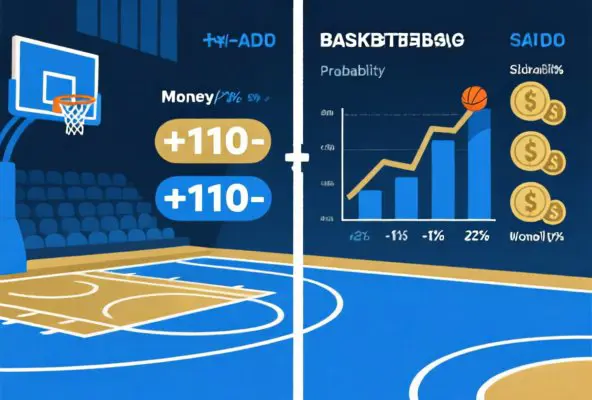
Editorial illustration showing basketball betting odds and implied probability concepts
Understanding basketball betting odds and probability
Quick Math: Implied Probability Formula
Negative odds: (100 / |odds|) x 100 = implied probability
Positive odds: 100 / (100 + odds) x 100 = implied probability

Example: -110 -> (100/110) x 100 = 52.4%
Example: +110 -> 100/210 x 100 = 47.6%

Point Spreads: Where Basketball Betting Really Lives

Point spread betting is what most basketball bettors focus on, and there's a good reason for that. Spreads let you find value in games where the moneyline pays nothing on favorites.

How Point Spreads Actually Work

A point spread is a handicap—the favorite has to win by more than the spread to cover, while the underdog covers by winning outright or losing by less than the spread.

Real Example:

Boston Celtics +2.5 (-110)
New York Knicks -2.5 (-110)
  • Knicks (-2.5): Need to win by 3 points or more. Exactly 2 points? That's a push—you get your money back.
  • Celtics (+2.5): Win outright, or lose by 1 or 2 points, and you're cashing tickets.

Typical NBA Spread Ranges

Once you've been around the block, you start recognizing what spreads mean:

  • Evenly matched teams: -1 to -3 (pick'em games essentially)
  • Typical favorites: -4 to -8 (standard NBA mismatch)
  • Significant favorites: -9 to -12 (someone's getting blown out)
  • Major mismatches: -13 or more (garbage time incoming)

Home Court: The Hidden Points

In the NBA, playing at home usually adds 2-3 points to the spread. Two evenly matched teams? Home team's probably favored by -2.5. But not all home courts are created equal—some places (looking at you, Utah and Denver) are legitimately tough for visiting teams due to altitude or atmosphere.

Betting Quarters and Halves

You're not stuck betting full games. Most books offer:

  • First Half: First two quarters only
  • Second Half: Third and fourth quarters (OT counts here)
  • Quarter bets: Individual quarters

Here's something I've noticed: favorites often come out strong in the first quarter when energy's high, then games get tighter as rotations expand. Worth watching for.

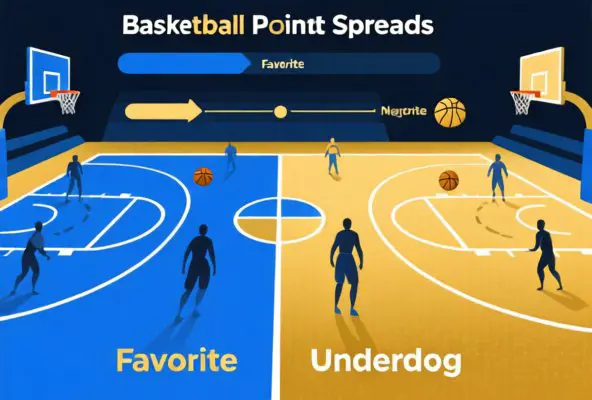
Editorial illustration of basketball point spreads with basketball court graphics and visual handicapping concepts
Understanding basketball point spreads and handicapping

Understanding point spreads is crucial for basketball betting success. The handicap system creates balanced opportunities on both sides of any matchup, making even lopsided games interesting from a betting perspective.

The point spread levels the playing field in any game, no matter the mismatch. The negative value indicates the favorite, who must win by more than that number, while the underdog has a positive value and can win outright or lose by less than that number.

Covers.com Betting Guide

Moneyline Betting: Just Pick the Winner

Sometimes you don't want to mess with spreads. Moneyline betting is exactly what it sounds like—pick who wins, straight up.

When Moneylines Actually Make Sense

I don't bet moneylines often, but here's when they work:

  1. Small underdogs: Teams at +150 or better can offer value without the spread headache
  2. Favorite wins but doesn't cover: You think they win but not by enough
  3. True pick 'ems: When the spread's basically a coin flip anyway

Example:

Los Angeles Lakers -140 vs. Golden State Warriors +120
  • Lakers (-140): Risk $140 to win $100
  • Warriors (+120): Risk $100 to win $120

Pro tip: avoid moneylines on heavy favorites (-300 or worse). The payout's so poor that one upset wipes out weeks of small wins. Trust me—I learned this the hard way.

Covers.com Betting Analyst

Moneyline betting is the most straightforward bet out there. It takes the least amount of math and homework. You're simply picking a winner.

Chris Vasile

Over/Under Betting: Forget Who Wins

Over/under basketball betting skips the winner entirely and focuses on total points scored. Combined score of both teams, over or under a set number.

Example:

Memphis Grizzlies vs. Golden State Warriors
Over 228.5 (-110)
Under 228.5 (-110)
  • Over 228.5: Combined score hits 229 or higher—you win
  • Under 228.5: Combined score stays at 228 or lower—you win

How Books Set These Numbers

Oddsmakers aren't pulling totals out of thin air. They're looking at:

  1. Team pace: Faster play = more possessions = more points
  2. Offensive efficiency: Points per possession tells the real story
  3. Defense: Some teams actually play D (shocking, I know)
  4. Injuries: Star offensive player out? Total goes down. Defensive specialist out? Total goes up
  5. Rest: Tired legs = fewer points
  6. Home/away: Some teams can't score on the road

The Overtime Bonus

Good news for Over bettors: overtime counts. Five extra minutes usually means 10-15 more points. If your game's tight late and headed to OT, Over tickets get a nice boost.

NBA vs. EuroLeague Totals

NBA totals: usually 220-240 points, wild variance, public inflates Over numbers constantly

EuroLeague totals: typically 150-170 points, slower pace, Unders hit more often

Covers.com

The general public usually likes to take the Over and inflate the number, so sharper bettors will find themselves backing the Under more often than not and coming out with a profit.

Trevor Knapp

Prop Bets: Where the Fun Is

Props have gotten huge lately, and I get why—instead of worrying about who wins, you're betting on specific outcomes. Points, rebounds, assists—it's fantasy sports come to life. For a deeper dive into finding value in these markets, check out our comprehensive prop betting strategy guide.

Types of Basketball Props

Player Props (where I spend most of my time):

  • Points/rebounds/assists individually
  • Three-pointers made
  • Combined stats (PRA: points + rebounds + assists)
  • Yes/no questions (LeBron over 29.5 points?)

Team Props:

  • First team to score
  • Quarter/half totals
  • Team totals (Celtics Over 112.5)
  • Odd/even total points (if you're feeling lucky)

Game Props:

  • Winning margin
  • Total threes by both teams
  • Lead changes
  • Highest scoring quarter

How I Approach Props

After years of betting props, here's what works:

  1. Watch usage rates: Star goes down, someone else gets more shots
  2. Check matchups: Great center vs. terrible interior defense? Easy money
  3. Track minutes: Player just back from injury? Probably on a minutes limit
  4. Shop lines: One book has someone at 25.5 points, another at 23.5—jump on that difference

NBA vs. EuroLeague Props

NBA: Deep prop markets, stats everywhere, players can explode for huge games

EuroLeague: Fewer options, consistent minutes, lower scoring ceilings

Editorial illustration comparing NBA and EuroLeague basketball with contrasting playing styles
NBA vs EuroLeague: Understanding key differences for betting

NBA vs. EuroLeague: Totally Different Games

If you're betting both NBA and EuroLeague the same way, you're leaving money on the table. These are completely different sports disguised as basketball.

The Big Differences

Factor NBA EuroLeague
Pace Fast and loose Slow and methodical
Typical Total 220-240 points 150-170 points
Market Efficiency Sharps everywhere Value lingers longer
Line Movement Instant Gradual
Public Influence Huge on big teams Minimal
Star Power League's about stars System over individuals
Props Available Tons Limited
Travel Impact 50,000+ miles/season Much less brutal

NBA: What Makes It Different

Playing style:

  • Stars drive everything—one player can completely control a game
  • Iso ball happens constantly
  • Fast pace, quick shots
  • Three-point obsession
  • Wild score variance

Market behavior:

  • Lines move FAST when news breaks
  • Public pounds Lakers/Celtics/Warriors regardless of value
  • Sharps pounce instantly on inefficiencies
  • Deep liquidity means big bets don't move lines much

EuroLeague: Another World

Playing style:

  • System over stars—team ball wins
  • Ball movement, sets, structured play
  • Slow, patient offense
  • Physical inside play, real team defense
  • Lower scores, more predictable

Market behavior:

  • Inefficiencies stick around longer
  • Mostly sharp money, less public action
  • Lines don't jump instantly
  • Smaller bets can actually move lines

Strategy Adjustments

For NBA:

  1. Matchups and availability are everything
  2. Load management can wreck your bets—watch those injury reports
  3. React fast to news
  4. Sometimes fade the public teams when lines look ridiculous

For EuroLeague:

  1. Study systems and coaching
  2. Tactical matchups matter more than individual stars
  3. Take advantage of slow line movement
  4. Look for structural advantages

NBA markets are some of the most efficient in sport. Lines move quickly, often before most bettors have had time to react. EuroLeague markets are quieter, with less public money and less media coverage. Prices move more slowly.

7bet.co.uk Analysis

Basketball Strategies That Actually Work

Let me give you strategies that've worked for me, starting basic and building up.

Beginner Stuff (Start Here)

Point spreads first: They're straightforward and teach you to think about margins, not just winners. Good learning environment.

One or two markets max: Don't try to master everything at once. Spreads and totals—get those down, then expand.

Check your fandom at the door: I'm serious. Betting your favorite team because you want them to win is a fast way to lose. Being a fan and being a bettor need different brains.

Leveling Up (Intermediate Strategies)

Fade the public: Casual bettors overvalue popular teams and stars. When lines look inflated by public money, the other side often has value.

Real example: Lakers are -4.5 against a solid team because public money pours in. Analytical models say it should be -2. Taking the dog there? That's where value lives.

Schedule spots matter: The NBA schedule is brutal, and tired teams lose:

  • Back-to-backs: Second night's especially tough when traveling
  • Rest advantages: Team with 2+ days off vs. team on back-to-back? Big edge
  • Long road trips: Five games away from home wears people down

Late game fade: Some teams can't close. Others live for clutch moments. Track fourth quarters—you'll find teams that consistently fade or cover late.

Matchup hunting: Elite point guard vs. terrible perimeter defense? That's a spot. Three-point reliant team vs. long, athletic defense? Probably fading that team.

Editorial illustration of bankroll management with coins, stacks, and betting discipline concepts
Bankroll management: The foundation of successful betting

Advanced Stuff (For When You're Ready)

Live Betting: Real-Time Action

Live betting during games is where basketball becomes insane. Constant scoring, huge momentum swings, odds shifting every possession.

NBA live betting:

  • Lines move instantly—zero hesitation
  • Small windows to act
  • High volatility, quick-thinking bettors can crush it

EuroLeague live:

  • More gradual movement
  • Time to actually think
  • Steadier opportunities

My approach: Watch for overreactions. Team goes on a 10-0 run, their odds get way too good. The other team's not actually that bad—you're getting value on the comeback.

Alternative Spreads

Books offer alternative spreads with adjusted odds, letting you tailor bets to your confidence level.

Example:

  • Standard: Celtics -4.5 (-110)
  • Alt 1: Celtics -8.5 (+150) — bigger payout, more risk
  • Alt 2: Celtics -1.5 (-145) — safer, smaller payout

I love this flexibility. When I'm confident, I take the extra points. When I like a team but want safety, I buy down the spread.

Hedging: Locking In Profit

Sometimes you place a bet, then circumstances change and you can guarantee profit by betting the other side.

Example: Bet a team early in the season at +1000 to win the championship. They make the finals as heavy favorites. Bet their opponent in the series—profit either way.

Middling: The Holy Grail

This is advanced but worth understanding. Bet both sides at different numbers, win both if the final score lands in the middle.

Example:

  • Early: Warriors -4.5 (-110)
  • Later line moves: Celtics +6.5 (-110)
  • Warriors win by exactly 5 or 6? Win BOTH bets

Requires line movement your way, experienced bettors only.

Bankroll Management: Don't Skip This

Nothing matters without proper bankroll management. This separates professionals from broke amateurs.

The Basics

1. Separate your bankroll:
Set aside money specifically for betting—money you can lose without problems. Never borrow or use rent money. This is entertainment, pure and simple.

2. Figure out your unit size:

  • Conservative: 1% per bet
  • Moderate: 2% per bet
  • Aggressive: 3% per bet

Real math: $1,000 bankroll, moderate 2% approach = $20 per bet.

3. Don't chase losses:
Biggest mistake beginners make. Losing streak hits, they double down to "get it back." Disaster. Stick to your unit size. Losing days, weeks, months—they happen to everyone.

4. Track everything:
Spreadsheet or app, but record:

  • Date and time
  • Teams/players
  • Bet type
  • Amount wagered
  • Odds
  • Result
  • Profit/loss
  • Notes on your thinking

5. Set limits:

  • Win limit: Hit your daily target? Stop. Greed kills profits.
  • Loss limit: Hit your max loss? Walk away. Tilt betting is expensive.

6. Adjust as you go:
Bankroll grows to $1,500 from $1,000? Your 2% unit becomes $30, not $20. Shrinks to $800? Drop to $16 per bet.

The Psychology Side

  • Discipline beats strategy: Great discipline with mediocre strategy beats great strategy with no discipline
  • Think long-term: Months and seasons, not single games
  • Control emotions: Wins don't make you a genius, losses don't make you an idiot
  • Patience: Building a bankroll takes time—overnight riches are a myth

Determine Your Unit Size. One of the cornerstones of bankroll management is deciding how much to wager on each NBA bet. This amount should typically range between 1% to 3% of your total bankroll.

HoopHeadsPod
Editorial illustration showing common basketball betting mistakes to avoid
Common pitfalls in basketball betting and how to avoid them

Mistakes That Cost Bettors Money

I've made plenty of these. Learn from my pain.

1. Terrible Bankroll Management

Betting too much per game = going broke fast. Never risk more than 3-5% of your bankroll on one bet, even for your strongest plays. Even the best pros only hit 55-60% on spreads.

2. Emotional Betting

  • Betting your favorite team no matter what
  • Increasing bets after wins to "ride the streak"
  • Chasing losses with bigger bets
  • Reacting to recent outcomes (betting against a team that just blew a lead)

3. Ignoring NBA Injuries

Single player injuries move NBA lines 4-6 points. Always check injury reports, monitor Twitter for late news—starting lineups drop 1-2 hours before tipoff.

4. Blindly Betting Overs

Just because the NBA scores a lot doesn't mean every game goes Over. Public pounds Overs constantly, creating Unders value for disciplined bettors.

5. Sleepwalking Through Schedules

Fatigue kills performance. Look for:

  • Second night of back-to-backs
  • Third game in four nights
  • Fifth game of a long road trip

These spots are gold for betting against the tired team.

6. Loving Heavy Favorites

Big favorites (-300 or worse) rarely offer long-term value. Upsets happen way more than casual fans think. Pros look for dog value, not favorite chalk.

7. One-Book Shopping

Different books offer different lines. That half-point difference? Wins and losses. Multiple accounts = always getting the best number.

Parlay Problems

Parlays combine multiple bets, bigger payouts but every leg must win. Common issues:

  • Too many legs: Each addition crushes your win probability. 4+ team parlays donate to sportsbooks long-term
  • Negative EV: Parlays pay less than true odds—books take bigger margins
  • Use sparingly: If you must, max 2-3 legs

Tools That Actually Help

Winning requires work. Here's what I use.

Stats Resources

Basketball-Reference.com:

  • Historical data going back decades
  • Advanced metrics (PER, Win Shares)
  • Team and player splits by situation

NBA.com/Stats:

  • Official league stats
  • Real-time game data
  • Player tracking info

StatMuse.com:

  • Search specific stat queries
  • Quick research interface
  • Trend analysis

Betting Tools

Odds comparison sites:

  • Compare across multiple books
  • Find the best price
  • Track line movement

Bet tracking apps:

  • Automatic recording and analysis
  • ROI and performance metrics
  • Identify your strengths and weaknesses

Injury aggregators:

  • Compile news from multiple sources
  • Real-time availability updates
  • Alerts for major injury news

News and Analysis

Beat writers on Twitter:

  • Local reporters break lineup news first
  • Practice participation info
  • Injury context beyond "active/inactive"

Betting analysis sites:

  • Covers.com, Action Network, The Lines
  • Professional handicapper analysis
  • Trend systems worth exploring

Advanced Metrics for Serious Bettors

Once you're comfortable, incorporate advanced stats:

Pace: Possessions per game. Faster pace = more scoring = higher totals.

Offensive Rating: Points per 100 possessions. Measures offensive efficiency independent of pace.

Defensive Rating: Points allowed per 100 possessions. How good is the D really?

Net Rating: Point difference per 100 possessions (offensive minus defensive). Overall team quality measure.

Player Efficiency Rating (PER): Player productivity per minute.

Usage Rate: Percentage of team plays used by a player while on court. Huge for props.

These give you deeper insights than traditional stats and an edge over casual bettors.

ℹ️

Bet Responsibly or Don't Bet

Sports betting can be fun and occasionally profitable, but it can also ruin you if you're not careful. Never bet money you can't lose. Treat it as entertainment, not income. Warning signs: betting more than you can afford, chasing losses, lying about your betting, or neglecting responsibilities. Help exists: National Problem Gambling Helpline: 1-800-522-4700 (US), BeGambleAware.org (UK), or Gamblers Anonymous.

Putting It All Together

Look, basketball betting offers something unique—accessible entry, deep complexity, and real opportunity. The high scores give you more data than low-scoring sports, and the statistical coverage means informed decisions are possible.

Whether you're betting NBA star-fests or EuroLeague chess matches, success comes down to fundamentals:

  1. Know the basics: Reading odds, understanding spreads, different bet types
  2. Build a strategy: Focus on markets where you can develop expertise
  3. Manage that bankroll: Never risk more than you can handle, no chasing
  4. Do the work: Injuries, schedule spots, matchups—they all matter
  5. Stay disciplined: Strategy through winning and losing streaks
  6. Be smart: Betting's entertainment, not a paycheck

Here's the truth no one wants to hear: even the best pros only win 55-60% of spread bets long-term. Anyone promising guaranteed wins or unrealistic percentages is lying to you.

The right approach? View sports betting as paid entertainment—where knowledge and discipline might make it profitable, but enjoyment comes first.

Now you've got what you need to make informed bets on NBA and EuroLeague games. Start small, track everything, keep learning, and enjoy the ride.

Professional headshot of Caleb Harrington, Senior Football & Betting Analyst

Caleb Harrington

Senior Football & Betting Analyst

Caleb Harrington is an experienced sports analyst and writer with over 8 years of expertise in football betting markets and tennis predictions. A graduate of Sports Journalism, Caleb combines deep statistical knowledge with an engaging writing style to make complex betting concepts accessible to all readers. He's particularly known for his data-driven approach to Premier League analysis and his insightful coverage of major tennis tournaments. When he's not analyzing odds or writing match previews, Caleb enjoys exploring emerging trends in sports betting technology and strategy.