Tennis

ATP Finals 2026 Betting Guide: Turin, Round-Robin Strategy and Contenders

Sinner is out, Zverev leads the Race and Djokovic is fighting for a ticket. Here's how the Turin format works, who's in the frame and where the betting angles sit.

ATP Finals 2026 Betting Guide: Turin, Round-Robin Strategy and Contenders
On this page

ATP Finals 2026: Turin without its king

For two years the Nitto ATP Finals followed one script. Jannik Sinner arrives in Turin, the home crowd goes up, and he leaves with the trophy without dropping a set. He did it in 2024, he did it again in 2025, and his record at the event stands at 15-2.

That script was torn up on Tuesday 6 October. Sinner announced he needs a course of treatment on his knee and that his 2026 season is officially over. He hasn't played since beating Alexander Zverev in the Wimbledon final in July, and he'd already pulled out of Canada, Cincinnati, the US Open, the China Open and Shanghai. The two-time reigning champion will be watching from the sidelines.

That leaves the 2026 ATP Finals, at the Inalpi Arena from 15 to 22 November, properly open for the first time in years. Good news for punters. The season is about 40 weeks old, the first ball is just over five weeks away, and there's still time to get ahead of the market. We'll take you through the format, the Race to Turin, the contenders and the markets, and by the end you'll know exactly who we fancy.


How the ATP Finals round robin works

Turin doesn't work like any other week on the tour, and the format is where a lot of the betting edge lives. Eight singles players are split into two round-robin groups of four. Each plays the other three in their group, the top two from each group go through, and the semi-finals are crossovers: a group winner meets the runner-up from the other group. The two semi-final winners meet in the final.

Matches are best of three sets with a standard tie-break in every set, the third included. There's no match tie-break in singles, so a decider is a full set. This is the sixth straight year in Turin, on an indoor hard court, and the 57th edition of the singles event.

The group tie-break rules

Most punters skim this part. Don't. If players finish level in a group, places are settled in this order:

  1. Most wins.
  2. Most matches played, so a player who went 2-1 ranks above one who went 2-0 after a withdrawal.
  3. Head-to-head result between the tied players.
  4. Highest percentage of sets won.
  5. Highest percentage of games won.
  6. ATP ranking after the last tour event of the season.

Steps four to six only come into play in a three-way tie. In a two-way tie, head-to-head decides it. So a 2-1 record can be enough even after a hiding, but in a three-way logjam every set and every game counts.

Race to Turin 2026: who is in and who is chasing

On paper, qualification is simple. The top seven in the Race to Turin after the Paris Masters are in. Up to two 2026 Grand Slam winners ranked between 8th and 20th get the next places, and after that the spot goes to the 8th-ranked player. Two alternates are named as well.

The Slam clause shouldn't matter this year. Carlos Alcaraz won the Australian Open, Zverev took Roland Garros and the US Open, and Sinner won Wimbledon. With all four majors shared between those three, the last place is a straight scrap on points. This is how the Race stood on 9 October.

Race position Player Points
1 Alexander Zverev (qualified) 8,760
2 Carlos Alcaraz (qualified) 4,560
3 Ben Shelton 4,440
4 Flavio Cobolli 3,540
5 Frances Tiafoe 3,340
6 Arthur Fils 3,285
7 Daniil Medvedev 3,030
8 Novak Djokovic 2,840
Alternate Alex de Minaur 2,690
Alternate Rafael Jodar 2,519

Sinner (7,950 points) qualified on 10 July but has withdrawn. Race as of 9 October 2026.

Only Zverev (6 August) and Alcaraz (16 September) are confirmed. Behind them, the gaps are small enough to move a lot in a month. Taylor Fritz (2,490), Jakub Mensik (2,405), Tommy Paul (2,395) and Felix Auger-Aliassime (2,375) are all within touching distance of the cut, with two Masters 1000s still to come.

What's left to play

Shanghai is under way and runs until 18 October. Then come the 250s in Almaty, Brussels and Lyon, the 500s in Vienna and Basel, and finally the Paris Masters, which locks the field. Every round in Shanghai and Paris shifts that table, and Shanghai has already thrown up two big results on Friday: Cobolli went out to Mannarino 6-1 4-6 6-3, and Djokovic lost 6-4 6-3 to Hurkacz in the second round.

ATP Finals 2026 contenders: Zverev, Alcaraz, Djokovic and Shelton

With Sinner gone, the outright market needs a new centre of gravity. These are the players we think matter.

Alexander Zverev

This is the season of Zverev's career. He finally broke his Grand Slam duck at Roland Garros, added the US Open, reached the Wimbledon final and made the semi-finals in Melbourne. He leads the Race by a street and was the first of the current field to book his place. He knows how to win this event, too: Zverev lifted the trophy in 2018 and again in 2021, when he beat Daniil Medvedev 6-4 6-4 in the first Turin final. His Shanghai campaign started with a 6-4 7-6(4) win over Wu.

Carlos Alcaraz

Alcaraz won the Australian Open, then a wrist injury cost him Roland Garros and Wimbledon. He came back at the US Open, reaching the quarter-finals, and has since won the Laver Cup and the Japan Open. The Finals is the one big title missing from his CV. He got to the final last year, losing 7-6(4) 7-5 to Sinner, and Greg Rusedski has named him as his favourite for Turin.

Novak Djokovic

Nobody has won this event more often. Djokovic is a record seven-time champion, and two of the five Turin finals are his: 7-5 6-3 against Casper Ruud in 2022 and 6-3 6-3 against Sinner in 2023. He beat Sinner in the Australian Open semi-finals this year and won the China Open in Beijing earlier this month. Rusedski calls him "the danger man". The catch is that he isn't in yet. He's eighth in the Race, 150 points clear of de Minaur, and already out of Shanghai.

Ben Shelton and the chasing pack

Shelton sits third in the Race after a four-title season that includes the Canada Masters, plus a run to the US Open final. His serve is a weapon worth respecting indoors, and he's into the third round in Shanghai after beating Altmaier 6-3 7-6(6). Cobolli, Tiafoe, Fils and Medvedev complete the current eight, and Medvedev has been a Turin finalist before.

Turin ATP Finals history: what five finals tell us

Turin finals don't hang about. All five have been won in straight sets, and four of them without a single tie-break.

Year Champion Runner-up Score
2021 Alexander Zverev Daniil Medvedev 6-4 6-4
2022 Novak Djokovic Casper Ruud 7-5 6-3
2023 Novak Djokovic Jannik Sinner 6-3 6-3
2024 Jannik Sinner Taylor Fritz 6-4 6-4
2025 Jannik Sinner Carlos Alcaraz 7-6(4) 7-5

Of the players in the frame for 2026, only Zverev and Djokovic have won here, and we think that's a real edge. The Finals asks you to play three elite opponents in six days before the knockouts even start. Knowing how to pace that week counts for plenty.

The Turin indoor hard court

Indoors there's no wind and no sun, so the serve carries more weight. On the courtspeed.com composite rating, which blends ace rate, rally length and other measures, Turin has historically been among the quicker hard courts on the tour: rated "Fast" in 2021, 2022, 2023 and 2025, and "Medium-fast" in 2024. Alcaraz said in 2025 that it felt a little faster than Paris early in the week and quickened as the centre court got more use.

For bettors, that points towards tie-breaks and tight sets when two big servers meet, and towards players who hold serve comfortably and can nick one break.

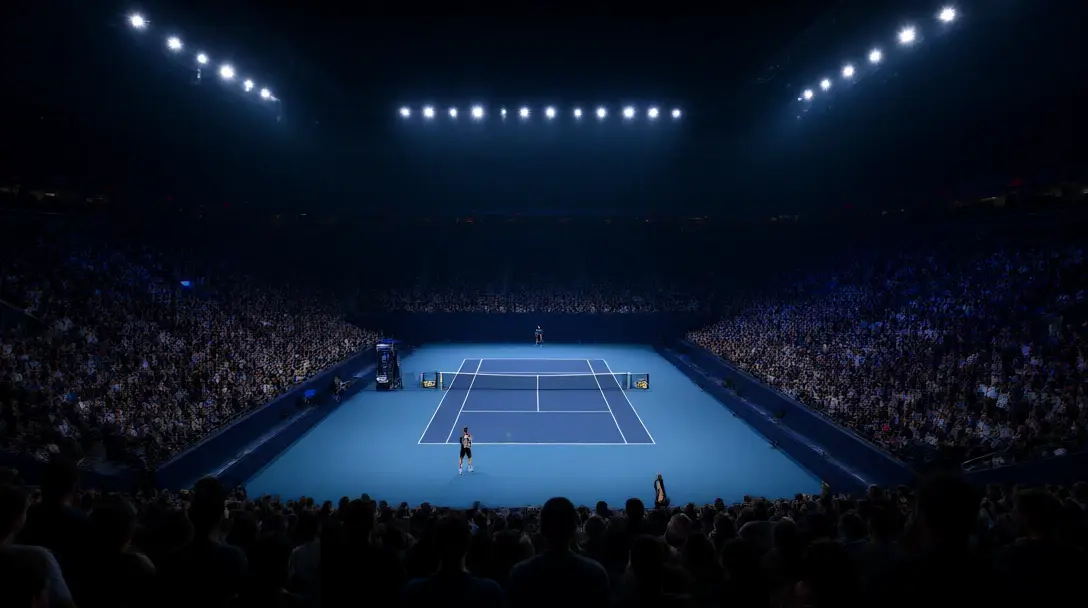
Silhouette of a tennis player serving on a fast indoor blue hard court under arena floodlights
Indoors in Turin there is no wind, so the serve carries extra weight.

Round-robin betting strategy: angles the market can miss

In Turin, losing your first match is a setback, not a sentence.

Round-robin tennis rewards punters who think about the whole week rather than one match at a time. These are the format quirks we always build in.

An opening defeat isn't fatal

Nobody goes home after one loss. Two wins from three is usually enough, and head-to-head settles a two-way tie, so a strong player who drops their opener is very much alive. Their price to qualify from the group can drift further than it should. That's often the moment to look at "to reach the semi-finals" rather than chasing them in match odds.

The dead rubber risk

The third round of group matches can feature players who are already through, or already out. A player who has qualified may manage their effort, especially with a semi-final around the corner. Before backing a qualified player in their final group match, ask what they actually need from it.

Margins matter in three-way ties

Sets and games percentages decide three-way ties, so a player chasing qualification sometimes needs to win in straight sets, or win a certain number of games. That changes how they play. It can also make set betting and games handicaps more interesting than the straight match price.

Read the withdrawal rules

Injuries and withdrawals happen, which is why the "most matches played" rule matters. Alternates can step in mid-tournament. Bookmakers settle retirements in different ways, so know each firm's tennis rules before you bet, particularly on outrights and group markets.

ATP Finals odds and markets explained

Thanks to the groups, the ATP Finals offers a deeper menu of markets than a normal tour event. Here's what you'll find and how we use them.

  • Outright winner. The headline market. Sinner's withdrawal has reshaped it, and there's plenty of movement still to come before the field is set.
  • Group winner and to qualify from the group. Once the draw is made, these are often the best-value markets, because they reward consistency across three matches rather than one result.
  • Match betting and set betting. Straight match odds, plus correct score in sets (2-0, 2-1). On a quick indoor court, 2-1 prices between two big servers are worth a look.
  • Total games and games handicap. In best-of-three with a tie-break in every set, a match can run from 12 games (6-0 6-0) to 39 (7-6 6-7 7-6), and big servers holding serve push totals up.
  • Specials. To win without dropping a set, first-set winner, a tie-break in the match, player to reach the final, and the group the winner comes from.

Spotting the bookmaker's margin

Every price has a margin built in. Convert the odds to implied probability and add them up: anything over 100% is the bookmaker's edge. Here's a worked example with illustrative prices.

Implied probability = 1 / decimal odds

Player A at 1/2   (1.50) -> 1 / 1.50 = 66.7%
Player B at 17/10 (2.70) -> 1 / 2.70 = 37.0%
Total                                = 103.7%

Bookmaker margin = 103.7% - 100% = 3.7%

The lower that total, the fairer the market. Compare several firms on the same match, take the best price on your side, and you shave that margin down.

If you like a bet once play is under way, our live betting guide covers how in-play prices move. For serve and return stats in more depth, head to the tennis betting guide.

Smartphone lying on a desk showing two odds buttons, 1.50 and 2.70, beside a tennis ball and notepad
Compare prices across firms to shave the bookmaker's margin.

Key dates for the ATP Finals 2026

Date Event
6 October Sinner ends his 2026 season
7-18 October Shanghai Masters 1000
19-25 October Almaty, Brussels and Lyon (ATP 250s)
26 October-1 November Vienna and Basel (ATP 500s)
2-8 November Paris Masters, the last qualifying event
15 November Round robin begins in Turin
21 November Semi-finals
22 November Final

The round robin runs from Sunday 15 to Friday 20 November, two matches a day, which leaves Saturday for the semi-finals and Sunday for the final. If you're planning ante-post bets, the sensible window for group markets is after Paris, once the eight names and the groups are known.

Our betting angles for Turin 2026

  • Zverev is our pick. The best season of his career, two majors, a commanding Race lead and two Finals titles already. He knows how to manage this week, and indoor conditions suit his serve.
  • Alcaraz is the main danger, not the banker. He's back winning titles and he's played in this final before, but the Finals is still the gap on his record. We'd want a price that reflects that.
  • Don't write Djokovic off, but don't back him blind. Seven titles here say he can win it; his Shanghai exit says he still has to qualify. Wait for the field before touching his outright price.
  • Wait for the draw for group markets. "To qualify from the group" is where we find the best value, and it only means something once the groups are set.
  • Back the bounce after an opening loss. A proven player who drops their first match can drift too far in the qualify market.
  • Respect the tie-break. Between two big servers on this court, tie-break specials and 2-1 set scores deserve a look alongside the straight match price.
  • Watch the final group day. Dead rubbers and three-way tie maths change motivation, so price that in before you bet.

Pick your spots across the week rather than firing at every session, and keep each stake to a set slice of your bankroll. Spreading your bets across group, qualify and outright markets is a sensible way to do it.

Topics