Odds

Betting Odds Explained: Fractional, Decimal and American Odds Made Simple

Fractions, decimals and moneylines all describe the same thing: how likely an outcome is and what it pays. Here's how to read each one, convert between them and spot the bookmaker's margin.

Betting Odds Explained: Fractional, Decimal and American Odds Made Simple
On this page

Betting odds explained: one price, three ways of writing it

Walk into a betting shop on a Saturday and the screen says 9/4. Flick your bookmaker's app over to decimal and the same horse is 3.25. Pull it up on an American site and it's +225. Same horse, same chance, same payout. Once you see that, betting odds stop looking like three different languages and start looking like one.

Every price tells you two things at once: how likely the bookmaker thinks something is, and how much you get back if it happens. Short price, likely outcome, small payout. Long price, unlikely outcome, big payout. Everything else is just notation.

Below you'll find all three odds formats with worked examples in pounds, a conversion table worth bookmarking, the racing terms that baffle newcomers (evens, odds-on, SP, "bar") and the spot where the bookmaker tucks its profit into every price. Get through it and no screen of odds will ever look foreign again.

Quick verdict

Switch your account to decimal odds. The stake is already included, prices compare at a glance and implied probability is one quick sum. Learn the fractions for the racecourse by all means, but do your thinking in decimals and percentages.

Fractional odds: the language of the betting ring

Fractional odds are the traditional British and Irish format, written with a slash or a hyphen: 5/1, 9/4, 11/8. You say them as "five to one" and so on. The left number is your profit and the right number is the stake needed to make it. So 2/1 pays £2 profit for every £1 you put down.

Where beginners come unstuck is that fractions show the winnings only. Your stake comes back on top, so your total return is profit plus stake.

Profit = stake x (left number / right number)
Return = profit + stake

£10 at 5/1   ->  10 x 5/1  = £50 profit,    £60 return
£4  at 9/4   ->  4 x 9/4   = £9 profit,     £13 return
£8  at 11/8  ->  8 x 11/8  = £11 profit,    £19 return
£10 at 9/4   ->  10 x 9/4  = £22.50 profit, £32.50 return

They behave like the fractions you learned at school, too. Scale both numbers up or down and the price stays put, so 6/4 and 3/2 are exactly the same bet. Bookmakers just have their habits about which one they print.

Why racing still talks in fractions

British bookmaking grew up on horse racing (our history of bookmaking in Britain tells the whole story), and the fractions go back to pounds, shillings and pence, a currency that was itself carved up into fractions. Britain went decimal in 1971, but the betting ring kept its old tongue. Fractions only started losing ground in the late 1990s, when online betting took off and brought decimals with it. Even so, prices like 9/4, 11/4 and 100/30 remain part of every racing punter's vocabulary.

Those in-between prices exist because the traditional price ladder moves in set steps. Between 2/1 and 3/1 you'll find 9/4, 5/2 and 11/4, and each one means something precise to a racing punter.

The ring even gave them nicknames. In bookmakers' slang, evens is "Scotch", 2/1 is a "bottle", 3/1 is "carpet", 100/30 is "Burlington Bertie", 9/2 is "on the shoulder", 5/1 is "ching" and 10/1 is a "cockle". Where most of those came from is anyone's guess, but we love them. They're a reminder of just how long these prices have been bellowed from a bookie's pitch.
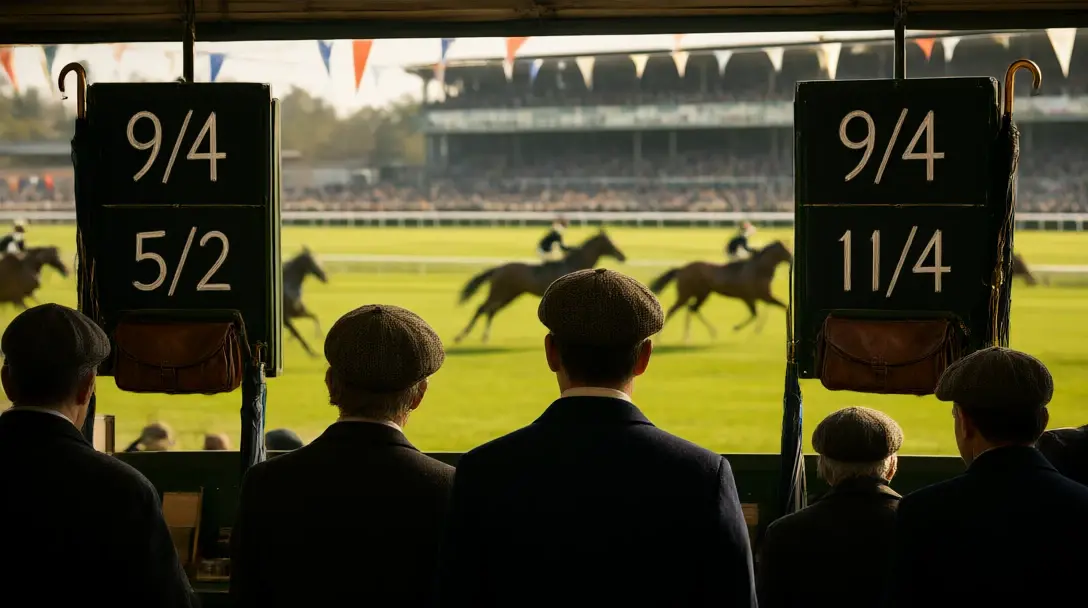
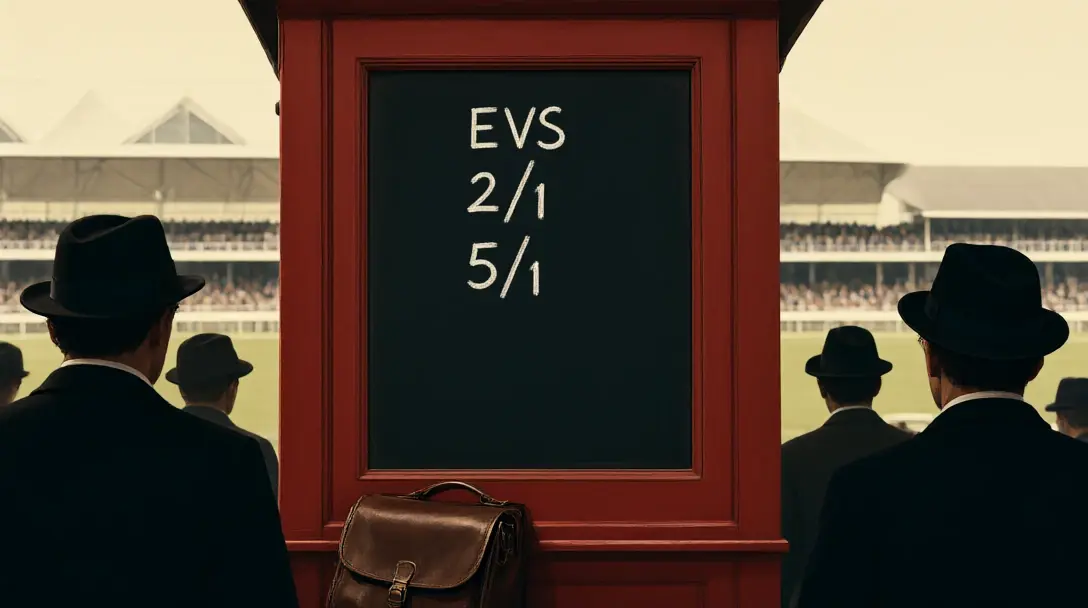
Vintage-style painting of a bookmaker's chalkboard with fractional prices at a British racecourse
Fractions stayed in the ring long after pounds, shillings and pence went.

Decimal odds: the stake is already in

Decimal odds are a single number, always above 1.00. They're the standard on betting exchanges such as Betfair and Smarkets, they're the norm across continental Europe, Australia, New Zealand and Canada, and more and more British bookmakers show them too.

The key difference: a decimal price includes your stake. Multiply your stake by the price and that's your total return. Knock off the stake and what's left is profit.

Return = stake x decimal odds
Profit = return - stake

£10 at 6.00  ->  £60 return, £50 profit
£10 at 1.80  ->  £18 return, £8 profit

Spot it? 6.00 is exactly the same bet as 5/1. That's the whole conversion trick: add one to a fraction to get the decimal. 5/2 becomes 3.50, and 11/8 becomes 2.375.

The 2.00 pivot

Evens is always 2.00 in decimal. Above 2.00 you're odds-against, winning more than you stake. Below 2.00 you're odds-on, winning less than you stake. It's the fastest way to get your bearings in any market, and it works for every format once you've converted.

Going back the other way is just as easy. Take one off the decimal, put the result over one and tidy it into whole numbers: 4.50 becomes 3.5/1, which is 7/2.

“I found myself having to deal with a lot of questions about the quirks of racehorse betting. Why, for example, does it go 3-1, 100-30, 7-2, 4-1?”

— Andrew Black, Betfair co-founder

American odds: plus, minus and the magic 100

American, or moneyline, odds look odd at first glance because they carry a plus or a minus sign. The thing to remember is that everything is measured against 100.

  • A minus number marks the favourite. It's the stake you need to win 100. At -200, you stake £200 to win £100.
  • A plus number marks the underdog. It's the profit you make on a 100 stake. At +250, a £100 stake wins £250.
  • +100 and -100 both mean evens. Profit equals stake.

Whichever sign you're looking at, your original stake comes back as well when you win. So £100 at +250 returns £350, and £150 at -150 returns £250.

Positive American (+A)  ->  decimal = A/100 + 1         e.g. +250 -> 3.50
Negative American (-A)  ->  decimal = 100/A + 1         e.g. -200 -> 1.50

Decimal 2.00 or above   ->  American = (decimal - 1) x 100      e.g. 3.50 -> +250
Decimal below 2.00      ->  American = -100 / (decimal - 1)     e.g. 1.50 -> -200

You'll rarely meet American odds at a UK bookmaker. They live on US-facing sites and in American sports coverage, so if you follow the NFL or NBA closely, it's worth reading them fluently.

Odds conversion table: fractional, decimal and American

These are the prices you'll bump into most often, lined up side by side. The return column includes your £10 stake, and every figure is a worked example rather than a live price. Rather let something else do the sums? Our betting calculators handle conversions and returns in seconds.

Fractional Decimal American Implied probability £10 returns
1/2 1.50 -200 66.7% £15.00
4/6 1.67 -150 60.0% £16.67
4/5 1.80 -125 55.6% £18.00
Evens (1/1) 2.00 +100 50.0% £20.00
6/4 2.50 +150 40.0% £25.00
2/1 3.00 +200 33.3% £30.00
5/2 3.50 +250 28.6% £35.00
3/1 4.00 +300 25.0% £40.00
5/1 6.00 +500 16.7% £60.00
10/1 11.00 +1000 9.1% £110.00
At the extremes, 1/4 is 1.25 (-400, 80%) and 100/1 is 101.00 (+10000, 1%).
The conversion formulas
Fractional a/b  ->  decimal = a/b + 1                  e.g. 5/2  -> 3.50
Decimal         ->  fractional = (decimal - 1) / 1     e.g. 4.50 -> 3.5/1 -> 7/2
Decimal         ->  implied probability = 1 / decimal  e.g. 3.50 -> 28.6%
Fractional a/b  ->  implied probability = b / (a + b)  e.g. 5/2  -> 2/7 = 28.6%
Return = stake x decimal;  Profit = stake x (decimal - 1) = stake x a/b

Implied probability: the skill that really matters

Swapping between formats is useful. Turning a price into a percentage chance is what actually makes you a sharper punter.

Implied probability is just one divided by the decimal price. With fractions, put the bottom number over the two numbers added together.

6.00   ->  1 / 6.00   = 16.7%
3.25   ->  1 / 3.25   = 30.8%
1.80   ->  1 / 1.80   = 55.6%
11.00  ->  1 / 11.00  = 9.1%
6/4    ->  4 / (6 + 4) = 40%

There's a twist, though. Implied probability isn't the true chance. The bookmaker's margin is baked into every price, so the implied figure sits a touch above the real likelihood. That's where the craft comes in: you set the bookmaker's percentage against your own. Reckon a side wins 45% of the time while the price implies 40%? Now you've got something worth a proper look.

Our guide to probability in sports betting takes that idea on into expected value, which is where serious punting begins.

“Shorter price, likelier outcome, smaller payout. Every format is saying the same thing.”

Evens, odds-on, SP and 'bar': the racing vocabulary

Racing has a dictionary all of its own, and four terms crop up again and again.

Evens, odds-on and odds-against

Evens (written EVS, 1/1 or 2.00) means your profit matches your stake. Odds-on means you win less than you stake: in fractions the bigger number sits on the bottom (1/2, 4/5), and in decimals the price is under 2.00. A £10 bet at 4/5 returns £18, so you're risking £10 to win £8. Odds-against covers everything longer than evens.

A long price like 50/1 says a horse has little chance but pays many times your stake. A short one like 6/4 says it's well fancied and pays a smaller profit. And take it from anyone who's spent time in a betting shop: a horse at 4/6 is not a certainty. Odds-on shots get turned over all the time.

Starting price and fixed odds

The starting price, or SP, is the price on a runner at the off. In British racing it's set under the rules of the Starting Price Regulatory Commission. A sample of on-course bookmakers' prices is ranked from longest to shortest and split into two equal halves, and the SP is the shortest price in the half with the longest odds. In plain terms, it's the median. Bookmakers under the same ownership count as one, so no single firm can swamp the sample.

On the day you can usually pick between a fixed price, which locks in the odds on offer when you bet, or the SP, which pays whatever the starting price turns out to be. For races further ahead, SP may be your only option. Some bookmakers also offer Best Odds Guaranteed, paying the better of your price and the SP, so read the terms on any racing bet. If your runner is withdrawn before the race, the stake on an SP bet comes back. Ante-post bets are often treated differently, so know the rules before you strike early.

What 'bar' means

You'll hear a bookmaker call "4/1 bar one". "Bar" means "except", so every horse in the race is 4/1 or bigger apart from the favourite. "20/1 bar" means all the others are 20/1 or longer. The phrase has been in print since at least 1860, which tells you how far back these traditions go.

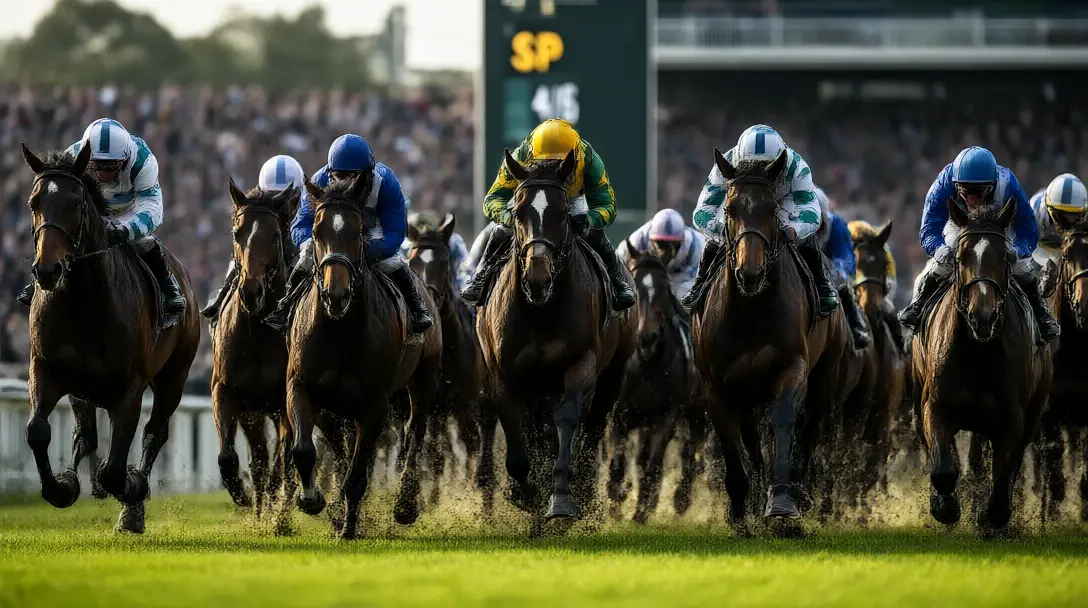
Racehorses and jockeys in silks charging to the finish at a British racecourse with a starting price board
The starting price is the price on a runner at the off.

Bookmaker margin and overround: where the profit hides

A full set of prices covering every outcome of an event is called a book. If the implied probabilities of all those outcomes added up to exactly 100%, the book would be fair. Bookmakers trim each price so the total comes to more than 100%, and that excess is the overround, also known as the margin or the vig. It's the bookmaker's expected profit, built in before a ball is kicked.

Here are three made-up prices for a football match (illustrative, not a live market):

Home 2.60  ->  1 / 2.60 = 38.46%
Draw 3.30  ->  1 / 3.30 = 30.30%
Away 2.90  ->  1 / 2.90 = 34.48%
Total                   = 103.25%   ->  overround of about 3.2%

Margin removed (simple proportional scaling):
Home 38.46 / 103.25 = 37.2%
Draw 30.30 / 103.25 = 29.3%
Away 34.48 / 103.25 = 33.4%

Real bookmakers use cleverer models than straight proportional scaling, but the principle holds. A deliberately exaggerated teaching example shows it starkly. Fair prices of Evens, 2/1 and 5/1 add up to 100%. Cut them to 4/6, 6/4 and 4/1 and they total 120%.

£60 at 4/6  ->  £100 return
£40 at 6/4  ->  £100 return
£20 at 4/1  ->  £100 return
Stakes taken £120, payout £100 whatever wins  ->  £20 profit = 16.67% of turnover

Margins compound in accumulators

Multiples are where the margin really bites. A coin-flip match priced at 5/6 on both sides makes a book of 109.09%. Put two of those in a double and the fair price would be 3/1 (4.00), because the true chance of landing both is one in four.

Fair double:      2.00 x 2.00 = 4.00 (3/1)
At 5/6 a leg:     1.833 x 1.833 = 3.36

The margin from each leg multiplies.

Margins also vary by league. One long-running study of six big bookmakers found the average Premier League margin fell from 9% in 2005/06 to 4% by 2017/18, while the Championship, League One and League Two came down from 11% to 6% and the National League from 11% to 8% over the same period. For the full method of stripping the margin out, see our guide to bookmaker margin and fair odds.

Betting shop screens full of football odds with a balance scale tipping towards a stack of pound coins
Add up the implied probabilities and the bookmaker's built-in margin shows.

Odds and markets explained: putting it to work

Knowing the formats is half the job. The other half is using them to place a sensible bet.

Format Where you'll see it What the number tells you
Fractional (5/2) UK and Irish bookmakers, racecourses Profit per unit staked; stake comes back on top
Decimal (3.50) Exchanges, Europe, Australia, many UK sites Total return per unit staked, stake included
American (+250 / -200) US-facing sites and analysis Profit on 100 (plus) or stake to win 100 (minus)

Pick the format that suits you. Plenty of online bookmakers let you switch between fractional and decimal in your account settings. We'd go decimal, because comparison becomes painless. Is 11/8 better than 6/4? In decimals it's 2.375 against 2.50, and you've got your answer in a blink.

Check the format before you confirm. The classic beginner's slip is mixing up profit and return when hopping between fractions and decimals. Glance at the potential return on your bet slip, since the bookmaker has already done the sums.

Think in percentages. Turn the price into an implied probability and ask whether you rate the chance higher. If you don't, there's no bet. Our beginner's guide to football betting strategies is built on exactly this habit.

Count the margin on multiples. Every extra leg adds the bookmaker's edge again, so an accumulator needs a lot more going for it than a single.

Our odds-reading angles

  • Learn decimals even if you love fractions. They include the stake, compare instantly and turn implied probability into a one-step sum.
  • Use 2.00 as your compass. Above it you're odds-against, below it you're odds-on, whatever format the screen shows.
  • Always convert to a percentage. A price only means something once you've set it against your own view of the chance.
  • Remember the margin is in every price. Add up the implied probabilities in any market and you'll see exactly how much the bookmaker has built in.
  • Respect odds-on shots, but don't treat them as bankers. A fairly priced 4/6 favourite still loses four times in every ten.
  • Know your SP from your fixed price. In racing, the choice between them, plus any Best Odds Guaranteed terms, can change what you collect.
  • Keep multiples in proportion. The margin compounds with every leg, so singles are the purer way to back an opinion.

Whatever format you read, set a staking plan before you bet and stick to it. No price, however tempting, is worth more than your budget.

Topics