Betting History

A History of Bookmaking in Britain: From Racecourse Pitches to Betting Apps

A man with a piece of chalk at Newmarket, runners dodging the police, drab shops with papered-over windows and, finally, a betting shop in every pocket. This is how Britain learned to bet.

A History of Bookmaking in Britain: From Racecourse Pitches to Betting Apps
On this page

Harry Ogden: the man with the chalk

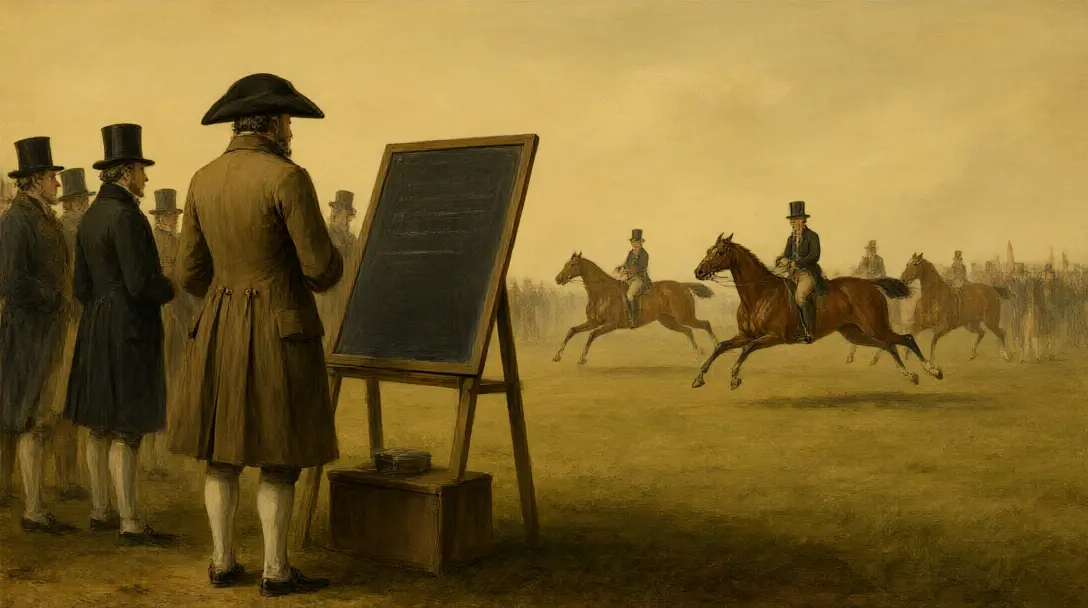
Picture Newmarket in the 1790s. Organised thoroughbred racing is already almost a century old, and the betting is simple to the point of crude: you can back the favourite, or you can back "the field". Everything that isn't the favourite gets lumped together as one big, lazy alternative.

Then, so the story goes, a man called Harry Ogden turns up and does something nobody taking bets has done before. He chalks up a price about every runner on the card. Punters love it, because suddenly the second favourite and the 20-1 shot each have their own odds. The layers love it too, because it makes them money. Before long, everyone is copying him.

Tradition calls Ogden the first bookmaker, and the date usually given is 1795. Whether or not he was truly first, his idea has lasted better than almost anything else from Georgian England. Every price you see on a betting app today, on a Premier League match or a Tuesday night at Wolverhampton, is a direct descendant of that chalk board.

The history of bookmaking in Britain is the story of that one idea surviving two centuries of moral panics, police raids, tax wheezes and technological upheaval. Know the story and you'll never look at tonight's prices the same way again.
The short version

Bookmaking in Britain started with Harry Ogden pricing every runner at Newmarket in the 1790s, and the business still runs on his sum: a book that adds up to a little more than 100%. Since then it has survived unenforceable debts, illegal street betting, the 1961 shop boom, the Betfair exchange and a new wave of taxes, and the chalk board now lives on your phone.

What Ogden actually invented

The genius of pricing every runner is that it turns a race into a complete set of probabilities. And the trick, then as now, is to make that set add up to a little more than 100%. That excess is the bookmaker's margin, known as the overround. If you want to see how to measure it and strip it out, our guide to removing the bookmaker margin to find fair odds walks through four methods.

Every decimal price hides a probability: divide 1 by the odds. Here's a coin flip priced fairly, then priced by a bookie, followed by a three-way football market. All the prices are illustrative:

The overround: a coin flip and a football match
Fair coin flip:     2.00 (evens) / 2.00 (evens)
Implied:            50.0% + 50.0% = 100.0%

Bookie's coin flip: 1.91 (10/11) / 1.91 (10/11)
Implied:            52.36% + 52.36% = 104.7%  ->  overround 4.7%

£1,000 staked on each side = £2,000 taken in
Winning side paid: £1,000 x 1.91 = £1,910
Bookie keeps £90, whichever side wins

Football 1X2 (illustrative prices)
Home 2.10 (11/10):  1 / 2.10 = 47.6%
Draw 3.40 (12/5):   1 / 3.40 = 29.4%
Away 3.60 (13/5):   1 / 3.60 = 27.8%
Book total:         104.8%  ->  overround 4.8%

The balanced book

That is the balanced book, and it explains why a bookmaker can be relaxed about a result while you're chewing your nails. The football market works exactly the same way: three prices instead of two, and a book that totals 104.8% rather than a clean 100%. That extra 4.8% is the price of admission.

Real books are rarely perfectly balanced, of course. Traders shade prices, take positions and lay off big liabilities elsewhere, and if you want to see how today's compilers set the opening numbers, our guide to how football betting markets are created takes you inside the process. But the core sum is Ogden's, more than 230 years on.

Debts of honour and runners faster than the police

For most of the 19th and early 20th centuries, British law treated betting like an embarrassing relative. The Gaming Act 1845 made gambling contracts legally unenforceable. If a bookie refused to pay you, tough: your winnings were a "debt of honour", and you couldn't take him to court. That quirk survived for 160 years.

The practical effect was that legal betting largely meant racecourse betting. Fortunately for the bookies, the railways arrived at just the right moment. Special excursion trains carried people of every class to new racecourses, and the crowds brought their cash with them.

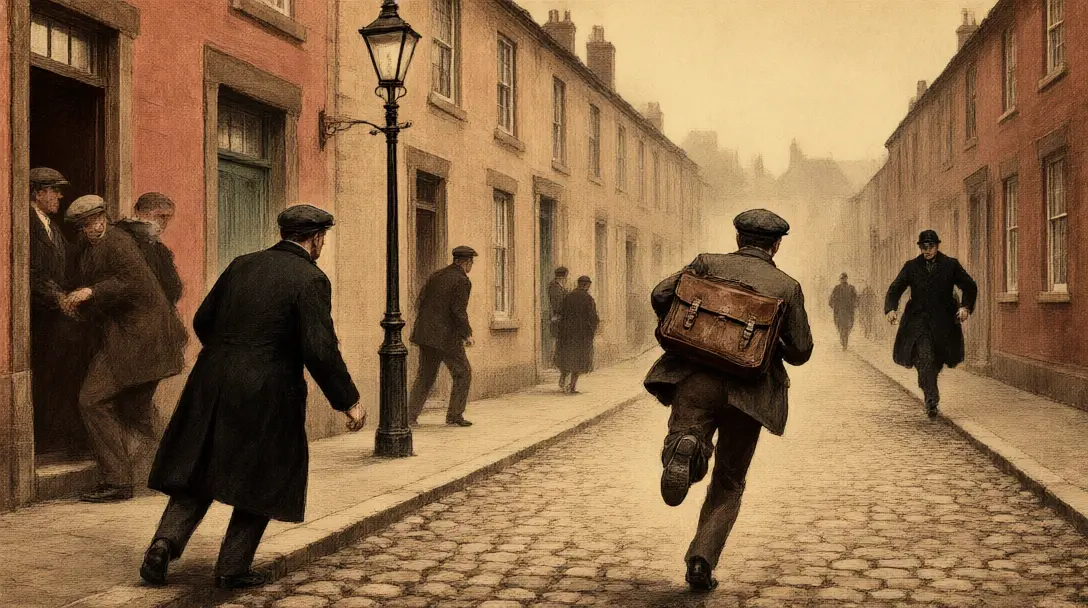
Away from the track, the trade went underground. A string of laws, from the Betting Act 1853 to the Street Betting Act 1906, tried to stamp out off-course cash betting. The bookmakers' answer was to hire runners who were quicker on their feet than the local constable, collecting punters' slips and cash in clock bags.

It was a rough, cash-heavy world. Bookmakers employed bodyguards to fend off protection gangs, and illegal betting shops were fined from time to time. Some, though, ran so openly that the police seemed to look the other way, and Bella Thomasson was one bookmaker whose business appeared to enjoy exactly that kind of tolerance.

Edwardian street scene with a bookie's runner in a flat cap fleeing a helmeted constable past terraced houses
Illegal street betting meant runners who had to be quicker than the local constable.

Churchill's two bets: a tax and the Tote

Winston Churchill shaped British betting twice in the space of a few years. As Chancellor he introduced Britain's first betting duty in 1926, a 2.5% tax on turnover. It was abandoned by 1930.

His second idea lasted much longer. The Racecourse Betting Act 1928 created the Racehorse Betting Control Board, a statutory body set up to give punters a safe, state-controlled alternative to illegal off-course bookies and to put some gambling money back into racing. Its first major meetings with tote betting were Newmarket's July Course and Carlisle on 2 July 1929.

The Tote works on a completely different principle from Ogden's chalk board. Everyone's stakes go into a pool, the operator takes a deduction, and the rest is shared among the winners. Nobody fixes your price when you bet; the dividend is only known once the pool closes. Our complete guide to Tote betting covers how the pools work today.

The Tote went on to have quite a life. It opened its first high-street shop in 1972, launched the Scoop6 with Channel 4 Racing in 1999 (with a record single-day turnover of more than £4m on 22 November 2008), was sold to Betfred for £265m in 2011, and passed to the UK Tote Group, a consortium of more than 150 racing investors, for £115m in 2019.

The famous names find their feet

Long before the high street was full of their shop fronts, Britain's biggest bookmaking brands were quietly building up very different businesses.

Ladbrokes: a club for gentlemen

Ladbrokes began in 1886 as commission agents for horses trained at Ladbroke Hall in Warwickshire, and took the Ladbrokes name in 1902 when Arthur Bendir joined and moved the operation to London. From 1913 to 1956 it served the aristocracy and upper classes almost exclusively, from the gentlemen's clubs of St James's. Its long-serving racecourse representative was a woman, Helen Vernet, who joined in 1919 and became a partner in 1928.

In 1956 Mark Stein and his nephew Cyril bought the firm for a reported £100,000. That purchase would transform it.

Coral: the dog-track bookie

Joe Coral started out in 1926, working mainly on racecourse and greyhound-track pitches at Harringay, White City, Clapton and Walthamstow. He opened a West End credit office in 1943, which is a telling detail: credit betting by post or phone was legal even when cash betting off the course wasn't.

William Hill: the shops came late

The William Hill company dates from 1934. Its first shops arrived not by building them but by buying them: in December 1966 it paid £825,000 for Jack Swift's business, 18 shops mostly in London's West End. Hill himself retired in 1970 and died a year later.

1961: the first UK betting shops open

The big moment came with the Betting and Gaming Act 1960, built on the work of the Royal Commission on Betting, Lotteries and Gaming of 1949-51. Harold Macmillan's Conservative government legalised off-course betting shops, and from 1961 they began opening across the country. The aim was to take gambling off the street and put the runners out of business, a move the clergy welcomed.

Demand had clearly been there all along. Around 16,000 licences were granted by local magistrates by 1965. Joe Coral was one of the first to jump in, opening his first licensed betting office in 1961.

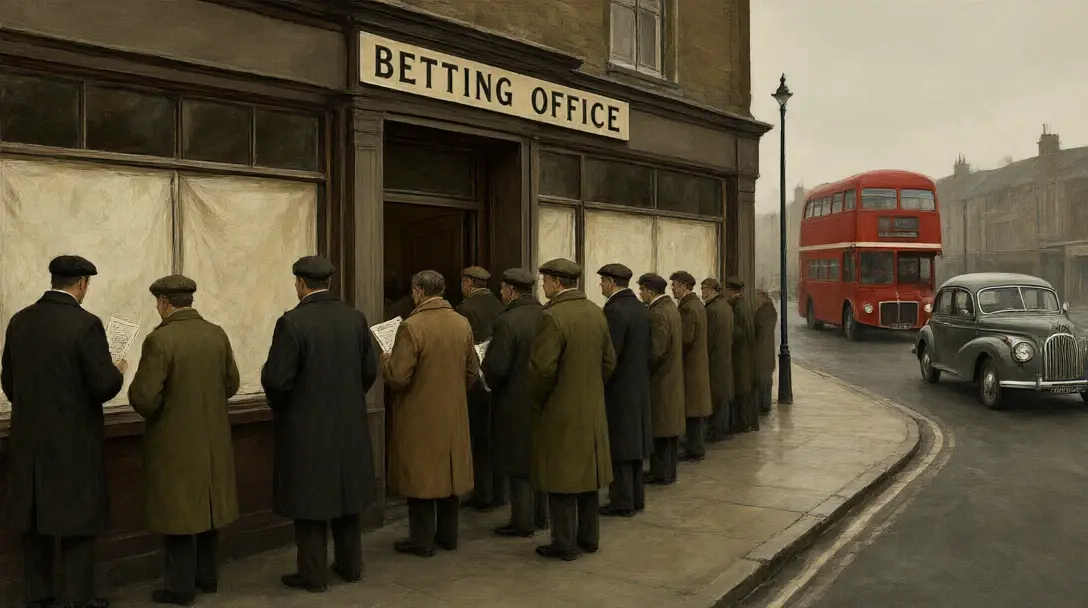
Don't imagine anything glamorous. Early shops were deliberately unattractive and stripped of comforts, because the law was not meant to encourage betting. Windows had to be covered, so you couldn't see in from the street. And there were no live pictures: shops weren't allowed live broadcast coverage until 1986, when Satellite Information Services was formed to screen the racing.

The winners were the firms that scaled fastest. Ladbrokes floated on the London Stock Exchange in 1967 and went from fewer than 50 shops to 1,135 by 1973. The losers included greyhound racing, which saw 21 NGRC tracks close between 1961 and 1969 as punters no longer needed to go to the dogs to have a bet. At one point Britain had more than 15,000 betting shops.

1961 British high street betting shop with papered-over windows, men in overcoats queueing and a vintage bus passing
From 1961 the shops opened, but the law kept them deliberately drab.

Offshore, Gordon Brown and the exchange revolution

By the late 1990s the shops faced a new threat. For decades punters had paid betting duty on their bets, and the internet suddenly made it easy to bet somewhere that didn't charge it. Victor Chandler moved offshore, and British turnover was leaking abroad.

In 2001 Chancellor Gordon Brown scrapped the duty on punters' bets and replaced it with a 15% tax on bookmakers' gross profits. It was the first time since April 1968 that British punters could bet without contributing to the taxman. William Hill's chairman, John Brown, was delighted. Victor Chandler, which had gone offshore almost two years earlier, called it "a hollow victory" and described the new gross-profits tax as "another stealth tax".

At the same time, two businesses were being born that would change the shape of the industry. Betfair was founded in June 2000 by Andrew Black and Edward Wray, and it introduced British punters to the betting exchange. Instead of betting against a bookmaker, you bet against other punters, and the platform takes commission on your net winnings. You could lay a horse to lose as easily as back it to win. Betfair floated on the London Stock Exchange in October 2010 at £13 a share, valuing it at around £1.4bn, and merged with Paddy Power in 2016 to form what is now Flutter Entertainment. The exchange idea has since spread beyond betting, as our explainer on prediction markets like Kalshi and Polymarket shows.

Around the turn of the century, bet365 started out too. By 2018 it employed more than 4,000 people, made an operating profit of £600m and paid its boss, Denise Coates, £265m. The bookie had moved from the racecourse rails to the server room, a shift we explore in traders vs algorithms in modern bookmaking.

“But most of all it would be great for punters, the majority of whom have never had the opportunity to bet deduction-free.”

— John Brown, William Hill chairman

The Gambling Act 2005 and the FOBT years

Tony Blair's Labour government overhauled the whole system with the Gambling Act 2005, which received Royal Assent on 7 April 2005. It moved licensing from magistrates to local authorities, created the Gambling Commission, and set three objectives: keep gambling crime-free, keep it fair and open, and protect children and the vulnerable. It was also the first Act to regulate internet gambling specifically.

Two changes mattered hugely to ordinary punters. First, the old "debt of honour" rule was finally removed, so after 160 years you could take legal action over unpaid winnings. Second, the Act allowed gambling adverts on TV and radio, and those provisions took effect in September 2007. Anyone who has watched a Premier League match since knows how that went.

The Act also legitimised high-stakes fixed-odds betting terminals on the high street, and they became the industry's most controversial product. Clustering of shops on some high streets became a political issue, and in April 2019 the maximum FOBT stake was cut from £100 to £2.

Offshore operators were brought back into the tent too. From 1 December 2014, any gambling brand serving British customers needed a Gambling Commission licence and had to pay a 15% point-of-consumption tax on gross profits, wherever the company was based.

Modern UK betting: white paper, tax rises and clean shirts

The government announced a review of the 2005 Act in December 2020, and in April 2023 it published the white paper "High stakes: gambling reform for the digital age". Its proposals included financial risk checks, a single customer view across operators, stake limits for online slots, player-set deposit limits and a review of bonus and free-bet advertising.

Then came the tax bill. The Autumn Budget 2025 pushed Remote Gaming Duty up from 21% to 40% from 1 April 2026, and a new remote General Betting Duty rate of 25% arrives on 1 April 2027. Betting in shops stays at 15%, and remote bets on UK horse racing are unchanged. The government says the package raises more than £1bn a year.

Seven weeks into the 2026/27 season, the change you can actually see is on the pitch. Premier League clubs voted to remove gambling logos from the front of their shirts from this season, twenty years after the door was opened to them. In each of the previous two seasons, 11 of the 20 clubs carried betting-firm branding, and eight had to find a new front-of-shirt sponsor this summer. Crystal Palace and Fulham swapped gambling partners for tech and AI firms.

The numbers tell the rest of the story. In the year to March 2026, Great Britain's gross gambling yield hit £17.5bn. Online casino, betting and bingo alone produced £8.3bn, far more than the £4.9bn from all the land-based sectors combined. And the betting shop count has fallen to 5,617, little more than a third of the peak. The chalk board has ended up in your pocket.

Fan's hand holding a phone with a betting app in a floodlit Premier League stadium, players in clean unbranded shirts
The chalk board now lives in your pocket, and the shirt fronts are clean.

Key dates in British bookmaking

Year What happened
1790s Harry Ogden prices every runner at Newmarket, by tradition the first bookmaker
1845 Gaming Act makes gambling debts unenforceable in court
1886 Ladbrokes begins as commission agents at Ladbroke Hall
1906 Street Betting Act targets off-course cash betting and the runners
1926 Joe Coral starts out; Churchill's 2.5% betting tax
1928 Racecourse Betting Act creates the Tote
1929 First major tote meetings at Newmarket and Carlisle (2 July)
1934 William Hill company founded
1961 Betting shops open after the Betting and Gaming Act 1960
1967 Ladbrokes floats on the London Stock Exchange
1986 Live pictures allowed in betting shops
2000 Betfair founded in June; bet365 starts out around the same time
2001 Gordon Brown scraps betting duty on punters' stakes
2005 Gambling Act creates the Gambling Commission
2014 Offshore operators serving Britain need a Gambling Commission licence (1 December)
2016 Paddy Power and Betfair merge; Ladbrokes and Coral merge
2019 Maximum FOBT stake cut from £100 to £2
2023 White paper "High stakes: gambling reform for the digital age"
2026 Remote Gaming Duty rises to 40%; gambling logos leave Premier League shirt fronts
2027 Remote General Betting Duty rises to 25% (1 April)

What two centuries of bookmaking teach a punter

The technology has changed beyond recognition, but the business model hasn't. The bookie's edge still comes from the same sum Ogden chalked up at Newmarket, so the better you understand it, the better you bet. As the Guardian once joked, Ogden might well chalk up the future of bookmaking at 10-11 each of two.

History also hands you a choice Ogden's punters never had. You can take a fixed price from a bookmaker, join a pool on the Tote, or bet person-to-person on an exchange. Each one suits different bets, and the sharpest punters use all three. If you enjoy the stories of punters who got one over on the layers, our round-up of the greatest betting coups in history is a fine next read.

Our betting angles from 230 years of history

  • Add up the book before you bet. Convert every price in a market to a percentage. The closer the total is to 100%, the less you're paying for the privilege.
  • Shop around, like punters did on the rails. Ogden's rivals soon copied him and competed for business. Today's bookmakers do the same, so never take the first price you see.
  • Use the Tote when the pool looks generous. A tote dividend isn't set by a trader, so it can sometimes beat the fixed price on offer. Compare before you commit.
  • Use the exchange to sanity-check prices. Betfair's back and lay prices show what punters collectively think, and if your bookie is offering a bigger price than the exchange back price, that's worth noticing.
  • Bet with licensed firms. The 2005 Act finally made winnings legally enforceable, and since 2014 every operator serving Britain has needed a Gambling Commission licence. That protection took 160 years to win, so use it.
  • Treat offers as marketing, not value. Bonuses and free bets came under scrutiny in the 2023 white paper for a reason. Judge the price, not the promotion.

Our take? Ogden's punters had a few chalk boards on the rails; you have dozens of firms, a Tote and an exchange in your pocket. That's the best deal punters have ever had, as long as you set a staking plan and stick to it, win or lose.

Topics