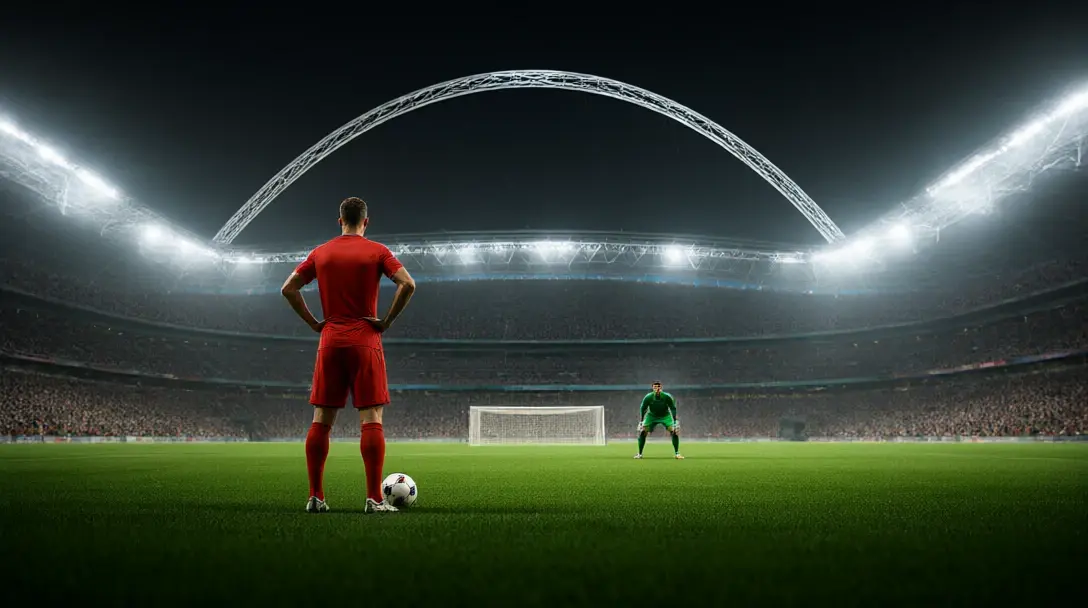
Penalty Shootouts

The Science of Penalty Shootouts: Game Theory, Data and Who Really Wins

Call it a lottery if you like, but a penalty shootout is a game of guesswork, nerve and surprisingly tidy maths. Here's what the research says about kickers, keepers and who really wins, and what it means for your bets.

The Science of Penalty Shootouts: Game Theory, Data and Who Really Wins
On this page

Twelve yards, one kick, nowhere to hide

Nothing else in football feels like it. The match is over, the ground has gone quiet, and one player sets off from the halfway line with the whole night on his shoulders. Score and you've done your job. Miss and you're the story for the next ten years.

IFAB brought in the shootout in 1970, and the World Cup got its first one in the 1982 semi-final: West Germany beat France 5-4 after a 3-3 draw, with Harald Schumacher saving two. There have been 39 World Cup shootouts since. Four of them came at the expanded 2026 tournament, where nine of the 32 knockout games went to extra time and four went the distance. Spain won the trophy without taking a single shootout kick.

And this isn't only a summer thing. The 2026/27 season is seven or eight weeks old, the cup rounds are rolling, and the EFL Cup goes straight to penalties after 90 minutes. No extra time. The Community Shield works the same way.

Everyone calls it a coin toss. That's only half the story, and the other half is where it gets interesting. Every kick is a little duel that game theorists have picked apart, the numbers on kickers and keepers are fascinating, and the old row over whether going first helps has a clear winner. Then there's the bit that matters most to us: how to bet on cup ties that could end at twelve yards.
The short version

A shootout is a near coin flip with a small thumb on the scale for the better side, and it's the kickers who crack far more often than the keepers win it. The famous first-kicker edge hasn't survived bigger datasets. For your bets, the value lies in judging whether a tie stays level, not in picking who wins from twelve yards.

Penalty game theory in sixty seconds

Boil a penalty down and you've got two people guessing. The kicker picks a side. So does the keeper, and he nearly always commits before the ball is struck, because there's no time to react once it's hit. Guess right and he has a chance. Guess wrong and the kicker will almost certainly score.

Game theorists call this shape matching pennies, and its golden rule is that any habit gets punished. The kicker who always goes left gets found out. The keeper who always dives to the kicker's strong side gets picked off. The only approach you can't beat is a mixed strategy: go each way with a set probability so nobody can read you.

The neat part is how those probabilities settle. At equilibrium, each player's mix leaves the other one with nothing to gain by changing. Take a simple made-up case where the kicker scores 90% of the time if the keeper goes the wrong way and 50% if he guesses right:

Both players go left or right 50/50

P(score | keeper dives left)  = 0.5 × 0.50 + 0.5 × 0.90 = 0.70
P(score | keeper dives right) = 0.5 × 0.90 + 0.5 × 0.50 = 0.70

Neither side can do better by switching: 70% scored

Real kickers aren't that tidy. Most have a natural side they strike harder and cleaner. Give our imaginary kicker a stronger natural side and the sums get more interesting:

Kicker's scoring chance        Keeper dives natural   Keeper dives other
Kick to natural side                  60%                   95%
Kick to other side                    92%                   50%

Kicker's best mix (natural side) = (0.92 - 0.50) / ((0.92 - 0.50) + (0.95 - 0.60))
                                 = 0.42 / 0.77 = 54.5%
Keeper's best mix (natural side) = (0.95 - 0.50) / 0.77 = 58.4%

Scoring rate at equilibrium      = 74.5%, whichever side the kicker picks

Here's the twist. The keeper should dive to the natural side more often than the kicker actually shoots there. The kicker's strength is real, but because the keeper leans into it, he can't just smash every penalty into his favourite corner. Both of them end up mixing, and the scoring rate comes out the same whichever way he goes.

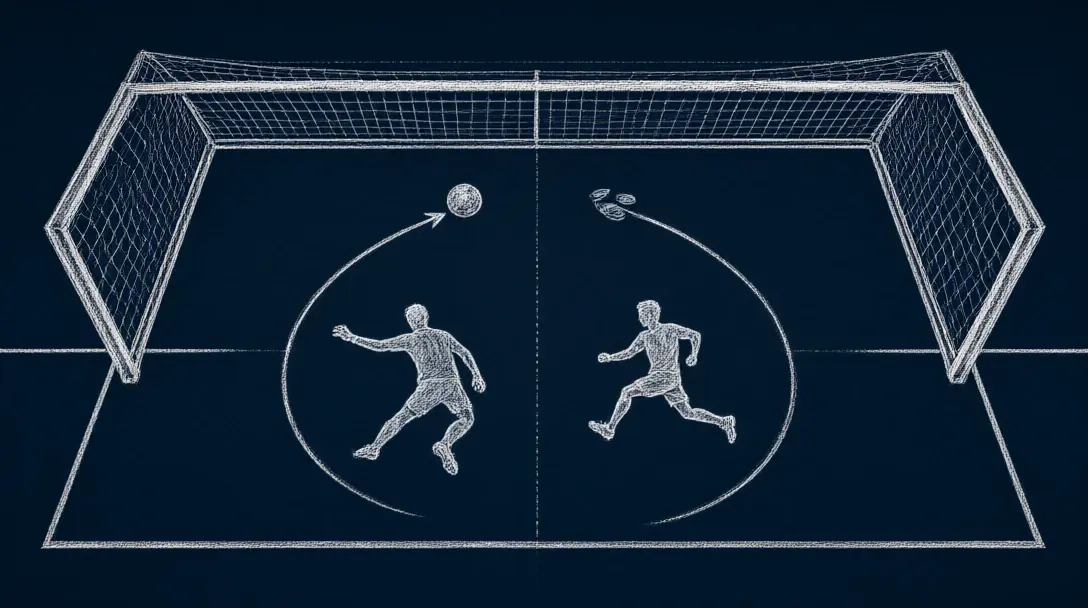
Chalk-style diagram of a penalty with the goal split in two halves, a diving keeper and a kicker's run-up
Kicker and keeper are both guessing, and the best strategy is to stay unpredictable.

Do footballers really play like economists?

This is the fun bit, because you can test it. If players are mixing properly, two things should show up in the data. Each player's scoring rate should be roughly the same whichever side he picks, and his choices shouldn't follow a pattern you could spot from his last few kicks.

Economist Ignacio Palacios-Huerta tested exactly that on European league penalties, as did a 2002 American Economic Review paper by Pierre-André Chiappori, Steven Levitt and Tim Groseclose. Both found professionals behaving remarkably close to what the theory predicts. Chiappori and co. went further, allowing for players who differ, with stronger natural sides and the option of going down the middle. The equilibrium story still held.

That's a cracking result. Ask most people to "be random" and they're hopeless, sliding into patterns without noticing. Elite kickers and keepers, with years of practice and real stakes, land close to the textbook answer.

For anyone watching from the sofa, the takeaway is simple: the side a player picks tells you very little. If his pattern were easy to read, keepers would already be cashing in on it.

Why shootouts are harder than penalties

Penalties in normal time fly in. On average one match in three sees a spot-kick awarded, and more than three in four of them are scored. Shootouts are a different beast.

A 2024 PLOS ONE study by Vollmer, Schoch and Brandes crunched roughly 50,000 penalties from eleven seasons of European men's football (2012-13 to 2022-23) plus the 2014, 2018 and 2022 World Cups. About a third came from more than 1,500 shootouts. Conversion in shootouts was significantly lower than in-game, even for regular takers. And it wasn't the keepers getting better. It was the shooting getting worse.

The World Cup record backs that up. Across every shootout so far, 247 of 360 kicks have gone in, or 68.6%:

Tournament Scored Taken Conversion
1986 21 27 77.8%
1990 28 38 73.7%
2006 21 33 63.6%
2014 26 36 72.2%
2018 26 39 66.7%
2022 26 41 63.4%
2026 25 40 62.5%
All World Cups 247 360 68.6%

Selected tournaments. Each one is a small sample, so year-to-year swings are mostly noise.

The recent dip is still worth a chat. 2022 and 2026 sit among the worst tournaments for shootout kicks. Qatar produced a record five shootouts, including Spain failing to score once against Morocco and going out 3-0. Before that, only Switzerland, against Ukraine in 2006, had drawn a complete blank.

Inside the goalkeeper's head

The keeper doesn't win the shootout. The kicker loses it.

If shootouts are mostly about kickers cracking, the keeper's job is to make cracking more likely. The great ones have always understood that.

The World Cup record for saves in one shootout is three, and three keepers share it. Ricardo kept out Frank Lampard, Steven Gerrard and Jamie Carragher as Portugal beat England 3-1 in Gelsenkirchen in 2006. Danijel Subašić denied Christian Eriksen, Lasse Schöne and Nicolai Jørgensen for Croatia against Denmark in 2018. Dominik Livaković then stopped Takumi Minamino, Maya Yoshida and Kaoru Mitoma against Japan in 2022. None of them quite touches Helmut Duckadam, who saved four in a row for Steaua Bucharest against Barcelona in the 1986 European Cup final, diving right three times and left once.

Homework isn't new, either. Hans van Breukelen kept a box of cards logging specialist takers' habits, and Ricardo's night in 2006 was built on reading the men in front of him.

Keepers are human, too

Keepers carry their own biases. A 2011 study in Psychological Science found goalkeepers dived right 71% of the time when their team was losing, against 48% when ahead and 49% when level. The pattern has been linked to a right-sided preference seen in social mammals, and it's a lovely reminder that even the coolest keeper is running on instinct when the scoreboard turns against him.

Then there's the gamesmanship. Bruce Grobbelaar's "wobbly legs" against Roma's Francesco Graziani in the 1984 European Cup final is the classic, and research has tied distraction and delaying tactics by keepers to fewer goals for the kicker. The Laws rein it in: keepers have to stay on their line until the ball is kicked, and stalling tricks like cleaning boots can earn a booking.

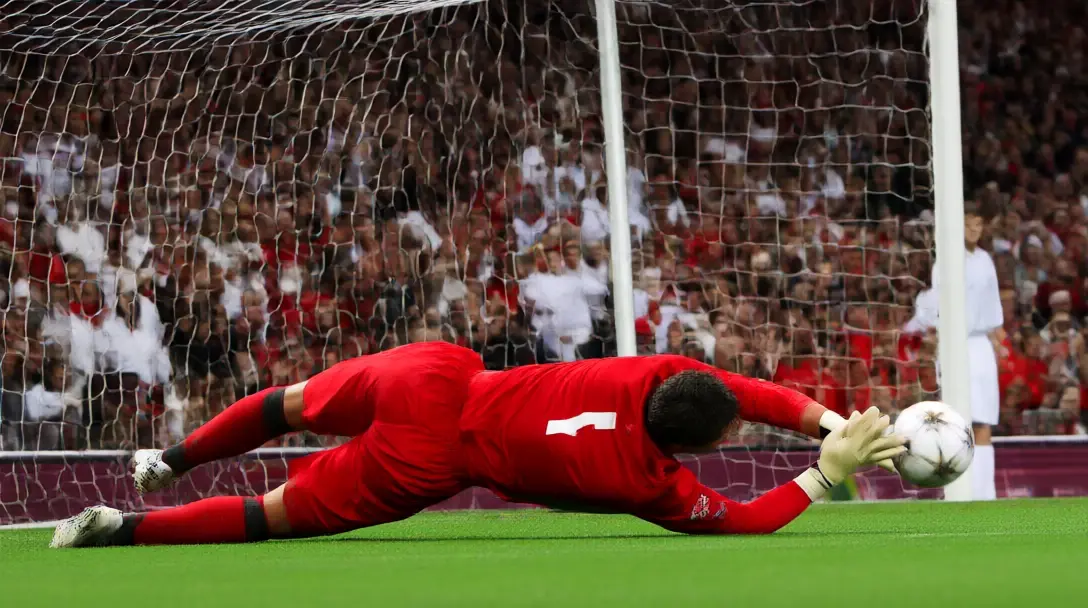
Portugal goalkeeper seen from behind diving at full stretch to save a penalty in a packed 2006 World Cup stadium
The great shootout keepers read their opponents, then commit before the ball is struck.

Does going first in a shootout really help?

No question in shootout science has caused more arguments, and the answer has moved a long way.

The theory sounds airtight. Kick second and you're often behind, so every kick comes with the scoreboard breathing down your neck. Ignacio Palacios-Huerta put a figure on it, with the team going first winning about 60% of shootouts. It became one of football's favourite stats, and he even proposed a fairer order based on the Thue-Morse sequence, A B B A B A A B, which keeps swapping who holds the edge.

Bigger datasets have worn it down. An InStat analysis of more than 2,000 shootouts had the team going first winning 51.48% of the time. A 2012 Management Science paper by Kocher, Lenz and Sutter widened the original sample from 129 shootouts to 540 and found no significant first-mover advantage. Then the 2024 PLOS ONE study, with its 1,500-plus European men's shootouts, found no statistical advantage for either side in the usual alternating order. The title does the talking: "Penalty shoot-outs are tough, but the alternating order is fair."

The ABBA experiment

Before the newer evidence landed, football's lawmakers had a go at fixing it anyway, pinching the serving pattern from a tennis tiebreak:

Date What happened
March 2017 IFAB sanctions trials of the ABBA order
11 May 2017 First ever use: Germany beat Norway in a Women's Under-17 semi-final
6 Aug 2017 Community Shield: Arsenal 1-1 Chelsea, Arsenal win 4-1 on penalties
22 Nov 2018 IFAB drops ABBA at its Glasgow meeting, citing its complexity

Our view: ABBA solved a problem the best recent data says barely exists. Who wins the toss is not a betting angle.

Lottery or skill? Both, but mostly lottery

"It's a lottery" is half right. There's evidence that team strength does predict shootout winners, which makes sense: better sides usually have better technicians and cooler heads. The edge is small, though, and a bit of arithmetic shows why. It's the same story we see when we ask which sports are the most unpredictable: the more the outcome hangs on a handful of single events, the more luck creeps in.

Picture a strong side converting 75% of its kicks against a weaker one at 65%. Treat every kick as independent:

Expected goals from five kicks:   Team A = 3.75   Team B = 3.25

After five kicks each:   A ahead 50.3%   level 25.6%   B ahead 24.1%

Sudden death, per round: A wins the round = 0.75 × 0.35 = 26.3%
                         B wins the round = 0.25 × 0.65 = 16.3%
                         A wins sudden death = 0.2625 / 0.425 = 61.8%

Team A wins overall ≈ 50.3% + (25.6% × 61.8%) ≈ 66%

A ten-point gap in conversion is huge, and it still only buys roughly a two-in-three chance. Shrink it to something more realistic and you're back near the coin toss in no time. Perfection is rare too: at 70% a kick, a side scores all five just 16.8% of the time (0.7 to the power of five).

So think of a shootout as a near coin flip with a thumb on the scale for the better team. Some skill, plenty of luck, and never something to be confident about.

England's penalty shootout record: the long road back

Few nations have a messier history with the shootout. England lost their first three at World Cups: the 1990 semi-final against West Germany, the 1998 round of 16 against Argentina and the 2006 quarter-final against Portugal, the Ricardo game. Heading into the 2018 round of 16 against Colombia, their competitive shootout record read one win and six defeats.

Then the script flipped. England beat Colombia 4-3 on penalties, Eric Dier tucking away the winner, for a first World Cup shootout win at the fourth attempt. Twenty-eight years of World Cup penalty misery, finished in one evening.

They're hardly alone in carrying scars. Italy, France and the Netherlands have each lost three World Cup shootouts, and Spain have lost four of their five, more than anyone. At the other end, Argentina have played seven and won six, and Croatia are four from four.

There's plenty more big-stage drama in our greatest World Cup moments, and our World Cup 2026 review covers what this summer taught us.

“They have prepared, they have made mistakes, they have corrected those mistakes.”

— Geir Jordet, professor of psychology and football at the Norwegian School of Sport Sciences, on England's shootout set-up

How penalty shootouts change your bets

Here's where the science earns its keep. Shootouts affect how plenty of markets settle, and getting the rules straight is half the battle.

90 minutes vs to qualify

A tie decided on penalties goes down as a draw for the match itself. Shootout goals don't count for the team or the players, which is why the Netherlands left the 2014 World Cup officially "undefeated". So the standard match result market and correct score betting settle on the score after 90 minutes, while "to qualify" and "to lift the trophy" include extra time and penalties. Settlement on the more specialist markets varies from bookmaker to bookmaker, so give the terms a quick look.

Method of victory

These markets split a win three ways: in 90 minutes, in extra time or on penalties. The research points one way here. The shootout leg is close to a coin flip with a modest edge for the better side, and there's no reliable edge from who kicks first. The value lies in judging how likely the game is to still be level after 120 minutes, not in second-guessing the shootout.

Cup ties with no extra time

In the EFL Cup and the Community Shield, the chance of penalties is simply the chance of a draw after 90 minutes. That puts low-scoring, evenly matched ties firmly in the frame for "match to go to penalties" markets. Two-legged European ties have their own aggregate-score quirks, which we unpick in our guide to knockout-stage betting strategies.

Our betting angles on penalty shootouts

  • Price the draw, not the shootout. In method-of-victory and "to go to penalties" markets, the real question is whether the game stays level, not who's better from twelve yards.
  • Give the stronger side only a small shootout edge. Even a big gap in conversion rate only turns into roughly two-in-three, so steer clear of short prices on a team "to win on penalties".
  • Ignore the coin toss. The famous 60% first-kicker figure hasn't survived bigger datasets. Kicking order is not an angle.
  • Respect the pressure. Shootout conversion sits well below in-game penalties, and it's the kickers who wobble, so never price a shootout kick like a routine spot-kick.
  • Know your settlement. Match result and correct score stop at 90 minutes; "to qualify" runs to the end. Be clear which one you're backing.
  • Treat League Cup draws as live. With no extra time, a 1-1 goes straight to penalties, which keeps the draw price relevant in those ties.

Shootouts are high-variance by nature, so keep stakes small and flat on anything that hinges on one.

Topics