Sports Betting Cash Out Psychology: Why That Button Is Hard to Resist

Sports Betting Cash Out Psychology: Why That Button Is Hard to Resist

Jump to section

Introduction

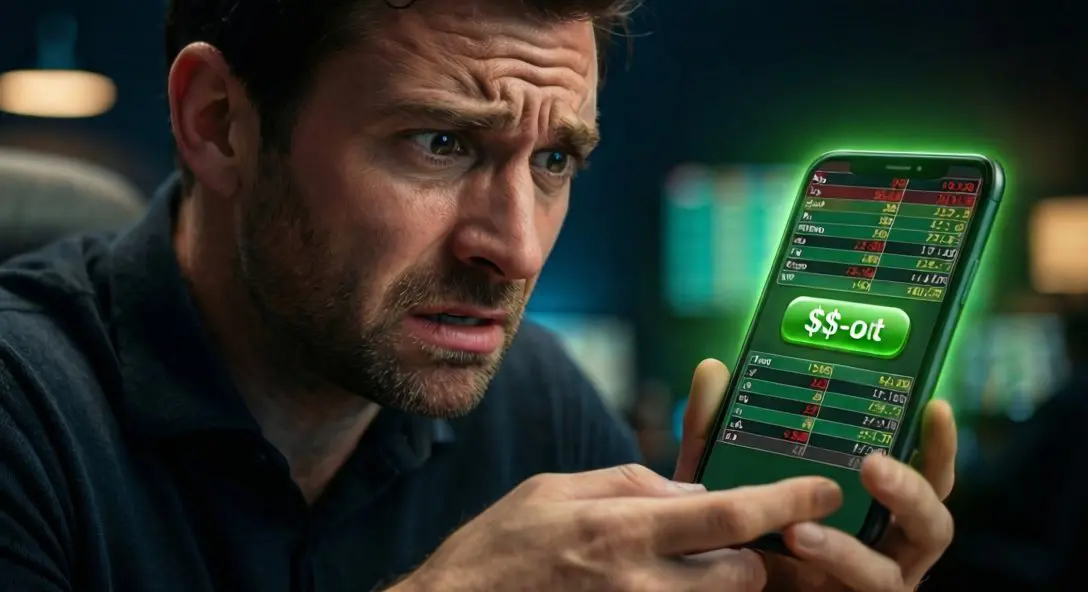
Your team is up 2-0 in the 75th minute. You've got $100 on them at even money, so $200 is sitting there for the taking. Then you see it: a pulsing green button offering $140 to cash out right now. Your heart races. Take the guaranteed profit or let it ride?

If you've ever frozen at this exact moment, you're in good company. Over half of in-play sports bettors report using the sports betting cash out feature, based on research from Addictive Behaviors. But here's what the sportsbooks won't tell you: that tempting button is one of the most sophisticated psychological tools in the gambling industry.

Getting a handle on why cash out decisions feel so tough, and how bookies have engineered them to exploit your brain's wiring, can turn you from an impulsive clicker into someone who actually thinks these things through.

The Hidden Math Behind the Sports Betting Cash Out

Before we talk psychology, let's look at what's actually happening when you hit cash out.

When a bookmaker offers you a cash-out amount, they're not doing you any favors. Research consistently shows that cash-out offers include a built-in profit margin of 5-15% for the house. Put simply: you're usually getting 85-95% of your bet's true fair value.

Let's break down our earlier example. If your team is up 2-0 in the 75th minute, historical data shows they've got roughly an 85% chance of winning. Your true expected value:

  • 85% chance of winning $200 = $170
  • 15% chance of losing $100 = -$15
  • True Expected Value: $155

But the bookmaker offers you $140. That's roughly 90% of fair value. The bookie pockets the difference as extra margin on top of their original vigorish. You're essentially paying twice for the privilege of certainty.

This doesn't mean cashing out is always wrong. But you need to understand the mathematical disadvantage before we get into the betting psychology battle.

PMC

Cashing out is financially disadvantageous because cash-out offers typically include a built-in profit margin for the bookmaker, meaning that users who cash out frequently will tend to see lower average returns from their bets.

Ngieng et al. (2025)

Loss Aversion: How Your Brain Processes Cash Out Decisions

Back in 1979, psychologists Daniel Kahneman and Amos Tversky published research that changed how we understand human decision-making. Their finding: the psychological pain of losing is roughly twice as intense as the pleasure of winning the same amount.

This principle, known as prospect theory, explains why that cash-out button feels so hard to resist when you're sitting on a profit.

Think about it. Losing $50 you never had doesn't sting nearly as much as losing $50 that was sitting in your hand. When you see a cash-out offer, your brain perceives that amount as money you already own. Letting the bet run now feels like gambling with "your" money rather than the house's.

This isn't a character flaw. It's how human brains work. Bookmakers know this, which is why they make cash-out buttons big, glowing, and front-and-center during live events.

The Endowment Effect in Sports Betting

The endowment effect goes hand in hand with loss aversion: we tend to value things more highly just because we think of them as "ours."

Here's how it plays out with cash-out:

  1. A cash-out offer appears on your screen
  2. Your brain immediately tags that amount as your money
  3. Letting the bet ride now feels like risking your own cash
  4. The fear of losing "your" cash-out value overrides any potential for more profit

The offer itself creates psychological ownership that didn't exist before you placed the bet. You stop thinking about expected value. You're thinking about protecting what feels like yours.

This emotional response to losing can lead to chasing losses, one of the most dangerous patterns in sports betting.

Addictive Behaviors

We found that cashing out was associated with increased problem gambling severity and increased gambling-related harms.

Sinclair et al. (2024)

The Certainty Effect: Why Guaranteed Money Feels Worth More

Consider this classic scenario from behavioral economics research:

Option A: A guaranteed $40 profit
Option B: A 70% chance at $60 profit (30% chance of nothing)

Mathematically, Option B has an expected value of $42 ($60 x 0.70), making it the better choice for a rational actor. Yet most people pick Option A because certainty itself has psychological value.

That's the certainty effect, and it's central to understanding why cash-out feels so appealing even when the math says otherwise.

Bookmakers exploit this by creating what researchers call a "Deal or No Deal" psychological pressure during live events. The cash-out value bounces around constantly, creating urgency and FOMO. Each refresh gives you a new "deal," and your brain treats each one as a decision point needing immediate action.

The irony? Studies show that teams leading at halftime win about 77% of matches (81% at home, 73% away). NBA teams down by 15+ points in the final five minutes win just 0.3% of games. In plenty of cases, your bet is safer than the cash-out offer suggests.

Present Bias in Gambling: The Trap of Instant Gratification

Why do so many bettors cash out when the math clearly favors waiting? Part of the answer lies in what psychologists call present bias or temporal discounting.

Humans systematically overvalue immediate rewards over delayed ones, even when the delayed rewards are substantially larger. This isn't just impatience. It's about how our brains process the value of future outcomes.

Cash-out gives you instant gratification. Click the button, money appears in your account right now. No sweating through a nerve-wracking final ten minutes. No anxiety about a late goal or a controversial penalty decision. Just instant resolution.

The problem gets worse because gambling itself triggers dopamine releases. The anticipation of a win, the suspense of a close match, the final whistle. These all create neurological rewards. Cash-out short-circuits this cycle, giving you immediate dopamine relief from anxiety.

For some bettors, this relief becomes its own form of reward. The cash-out button transforms from a strategic option into an emotional escape hatch.

How Bookmakers Design Cash-Out to Exploit Betting Cognitive Biases

Knowing the cognitive biases at play is one thing. Recognizing how deliberately sportsbooks have engineered their products to exploit these biases is another thing entirely.

Visual and Structural Design

The glowing button: Cash-out buttons are usually large, green or gold, and prominently placed in prime screen real estate. They're built to catch your eye and trigger impulse responses.

Constant updates: Cash-out values refresh non-stop during live events, creating urgency. The fluctuating numbers feel like a stock ticker, encouraging you to monitor constantly.

Strategic suspension: Bookmakers sometimes suspend cash-out offers during crucial moments (penalties, VAR reviews, injuries). When the offer comes back at a lower value, bettors may panic and accept before it drops further.

Marketing Framing

How do sportsbooks talk about cash-out in their ads?

  • "Take control of your bets"
  • "Manage your risk"
  • "Edit your bet in-play"

This language frames cash-out as a player-friendly feature giving you control. Reality check: research shows bookmakers make higher margins when players use cash-out frequently.

Timing Exploitation

Cash-out offers often appear or change during high-stress moments: when the opposition scores, when a star player goes down injured, when momentum shifts against you. Bookmakers know these are exactly when bettors are most vulnerable to fear-based decisions.

A study by Bennett et al. found that the mere availability of cash-out increases average wager amounts, with the effect strongest among those who cashed out most often. Put differently: the feature doesn't just extract value from individual bets. It encourages riskier betting behavior overall.

When to Cash Out Bets: Strategic Scenarios

Despite everything above, cashing out isn't always the wrong move. The trick is telling the difference between emotional and strategic cash-outs.

Here are legitimate scenarios where taking the money makes sense:

1. New Material Information

You bet on a team before kickoff. In the 20th minute, their star striker gets stretchered off. That fundamentally changes the match dynamics in a way your original analysis didn't account for.

Red cards, injuries, weather changes, tactical substitutions. These can all shift win probabilities by 15-25%. If the new information genuinely undermines your original thesis, cashing out may be rational.

2. Life-Changing Amounts

Picture this: You put $5 on a seven-leg parlay at 39,000-to-1 odds. Six legs have hit. You're one Mookie Betts home run away from $196,594.72. The bookie offers you $12,328 to cash out now.

Is the math on your side to hold? Probably not. Betts homers in roughly 5% of his at-bats, and with an estimated 2.5 remaining plate appearances, your true equity might be around $24,574. The offer is only about 50% of fair value.

But here's the thing: $12,328 is life-changing money for most people. $0 is devastating. Expected value calculations assume you can repeat the scenario thousands of times. You can't. This is a one-shot decision, and personal financial considerations legitimately override the math.

3. Bankroll Protection

Sometimes a single bet grows to represent disproportionate risk to your overall bankroll. If losing would devastate your betting funds for months, cashing out may be the responsible choice even if it's not the mathematically optimal one.

The better solution? Proper bankroll management and sizing your bets appropriately in the first place. If you'd need to cash out due to bankroll concerns, your original bet was probably too large.

4. Superior to Available Alternatives

Sometimes you can't bet the other side. Maybe you're geo-blocked from other books, or liquidity is too low, or the opposing odds are terrible. If cash-out genuinely beats any alternative hedging strategy, taking it may be rational.

Speaking of hedging...
Hedging vs Cashing Out: The Professional Approach

Professional bettors rarely touch the cash-out button. Instead, they hedge by placing an opposite bet at another sportsbook.

Here's why this usually works better:

Scenario:

  • $100 on Team A at +200 odds (potential $300 return)
  • Team A takes an early lead
  • Cash-out offered: $180
  • Team B now available at +120 at another book

Hedging approach: Bet $80 on Team B at +120

Outcome Cash-out Hedge
Team A wins $180 guaranteed $300 - $80 = $220
Team B wins N/A $176 - $100 = $76 profit
Cash-out vs Hedging outcomes comparison

Why Hedging Beats Cashing Out

The hedge gives you guaranteed profit either way, but the Team A win scenario pays $40 more than cashing out. Why? You're not paying the bookmaker's double margin.

This approach requires access to multiple sportsbooks and the ability to act quickly. But for serious bettors, it's almost always better than accepting a cash-out offer.

A Practical Cash Out Strategy Framework

How do you know whether to cash out? Before you click that button, run through this decision framework:

The Five-Question Test

1. Has anything materially changed since I placed the bet?

If no, cashing out is almost certainly emotional. Your original analysis should stand unless new information contradicts it.

2. Am I reacting to fear or new information?

Fear is not a strategy. If your hands are sweating and your stomach is churning, that's your amygdala talking, not your prefrontal cortex. Step back and reassess.

3. What's the expected value versus the cash-out offer?

Calculate: (Win Probability x Full Payout) minus (Loss Probability x Stake)

Compare this to the cash-out offer. Only consider accepting if the offer exceeds expected value by a significant margin (5% or more).

4. Can I hedge instead?

Check other sportsbooks. Calculate the guaranteed outcome from hedging versus cashing out. Hedging typically provides 10-20% better value.

5. Is this life-changing money?

If yes, personal financial considerations legitimately override expected value math. Just be honest with yourself about whether the amount truly qualifies.

Pre-Bet Planning

The best cash-out decisions happen before you even place the bet:

  • Set profit targets: "I'll only consider cashing out if offered 80%+ of potential winnings"
  • Set loss recovery thresholds: "I'll cash out losing positions only if I can recover 40%+ of my stake"
  • Identify trigger scenarios: What specific events (injuries, red cards, weather) would cause you to reassess?

When you have rules in place before the emotional pressure of a live bet, you're far more likely to make rational decisions.

The Surprising Truth About Who Cash-Outs Most

Here's a finding that goes against conventional wisdom: research published in 2025 found that less impulsive people are actually more likely to cash out.

Why would cautious bettors use a feature that's mathematically disadvantageous?

The researchers suggest cash-out may function as a "gateway product" for otherwise risk-averse individuals. By offering what looks like a safety net, the feature encourages people who might otherwise avoid betting to participate.

This doesn't mean you're weak for cashing out. It means the feature has been designed to appeal to psychological tendencies that exist across the personality spectrum, from impulsive risk-takers to cautious planners.

The key is self-awareness. Understanding your own psychological profile helps you recognize when cash-out is serving your interests versus when it's exploiting your biases.

Red Flags: When You Should Never Cash Out

Some cash-out scenarios are almost always mistakes:

Suspension tricks: If a cash-out offer gets suspended during a crucial moment and returns at a significantly lower value, don't panic-accept. This is often a deliberate tactic.

"I never win these anyway": Making decisions based on past outcomes rather than current probabilities is the gambler's fallacy. Each bet is independent.

Social pressure: Cashing out because friends are watching or because you've posted about the bet on social media adds unnecessary psychological complexity to what should be a purely analytical decision.

"Something always goes wrong": Pessimism isn't analysis. If your expected value calculations show the bet is worth holding, trust the math over your inner pessimist.

Offers significantly below expected value: If you've done the calculation and the cash-out offer is 50-70% of true equity, accepting it is mathematically equivalent to lighting money on fire.

Research Sources

Key sources:

  • Sinclair et al. (2024), "Cash outs during in-play sports betting: Who, why, and what it reveals" - Addictive Behaviors
  • Ngieng et al. (2025), "Greater impulsivity is associated with a reduced propensity to cash out of bets" - PMC
  • Bennett et al. (2024), "People place larger bets when risky choices provide a post-bet option to cash out" - Psychological Science
  • Lopez-Gonzalez & Griffiths, "'Cashing out' in sports betting: Implications for problem gambling and regulation" - Gaming Law Review
  • Kahneman & Tversky (1979), Prospect Theory foundational research

The Bottom Line

The cash-out button is one of the most brilliantly designed features in modern gambling. It hits multiple cognitive biases at once while generating extra profit margins for bookmakers.

But understanding the psychology doesn't mean you should never use it. Cash-out has legitimate applications:

  • When new information fundamentally changes your bet's expected value
  • When genuinely life-changing amounts are at stake
  • When bankroll protection is a legitimate concern
  • When the offer actually exceeds expected value (rare, but possible)

The goal isn't to eliminate emotional decision-making entirely. That's not realistic. The goal is to build enough self-awareness to recognize when your brain is getting hijacked by fear, certainty bias, or present bias, and to have a framework in place for making more deliberate choices.

Here's the thing: the glowing green button is designed to exploit predictable patterns in human psychology. That doesn't make you weak for feeling tempted. It makes you human. What matters is whether you can step back, recognize the psychological game being played, and make decisions that serve your long-term interests rather than your momentary emotions.

Your bankroll will thank you.

Professional headshot of Sophia Pemberton, Gambling & Casino Industry Analyst

Sophia Pemberton

Gambling & Casino Industry Analyst

Sophia Pemberton is a gambling industry expert specializing in online casinos, slot games, and betting strategies. With a background in mathematics and statistics, she brings a analytical approach to reviewing gambling platforms and explaining odds, RTP percentages, and game mechanics in accessible terms. Sophia has written extensively about responsible gambling practices and helps readers navigate the complex world of online betting. Her expertise covers bookmaker comparisons, bonus offer analysis, and strategic advice for casino games and sports betting markets.